Updated September 2, 2026 10:39AM
The Vuelta a España Is About to Get So Hot Officials Are Changing How Riders Get Water
The UCI makes a rare hydration-rule exception under its extreme heat protocol as temperatures threaten to top 100°F at the Vuelta a España.
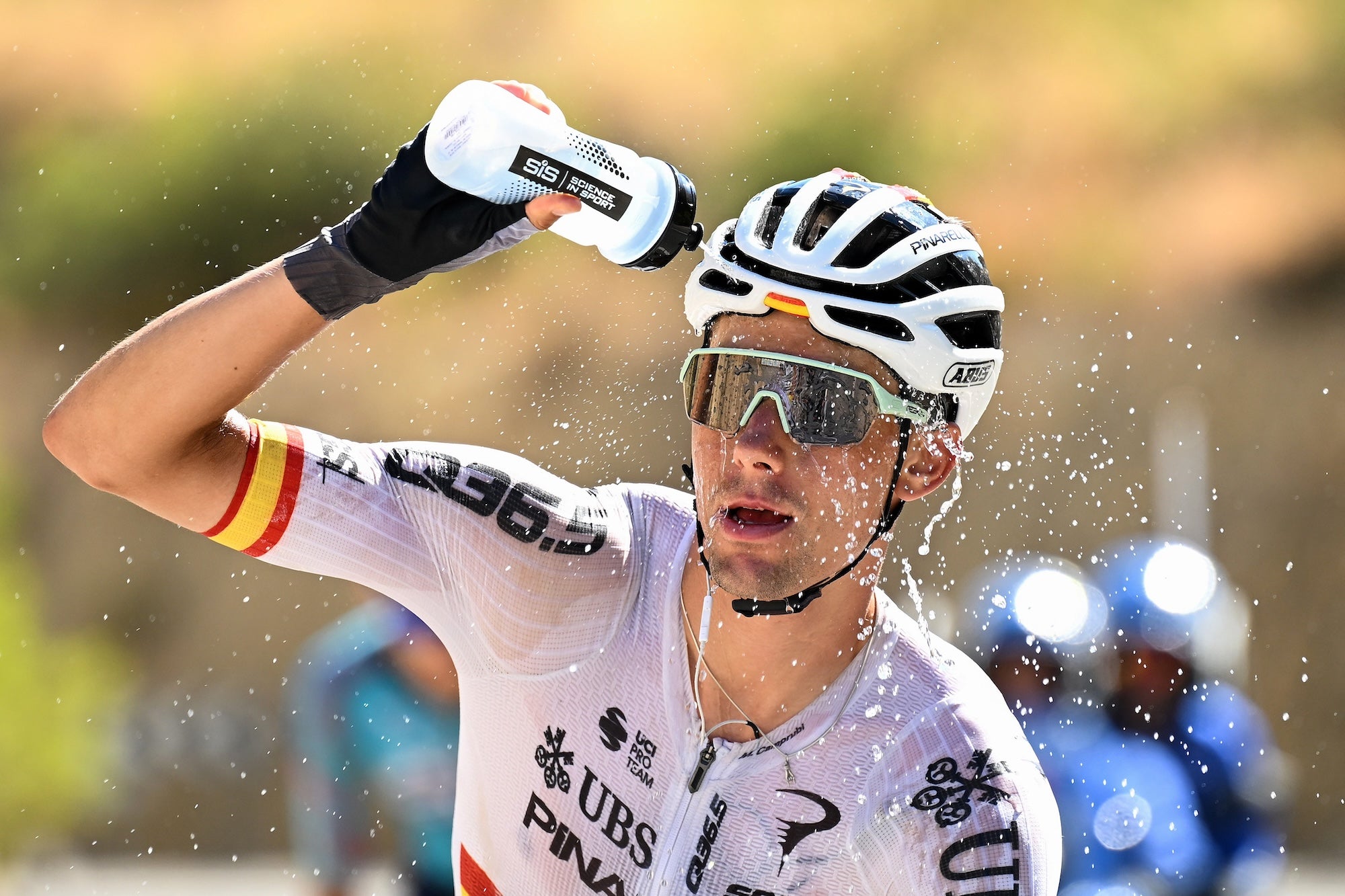
Marcel Camprubi keeps cool at the Vuelta a España. (Photo: Tim de Waele/Getty Images)
The Vuelta a España is about to get so hot that the UCI is loosening its feeding rules for Wednesday’s stage 11 in what it called an “exceptional authorization” to keep riders cool and hydrated.
Temperatures are expected to surge into the mid-90s Fahrenheit during the 153.8km race from Cartagena to Lorca, and UCI race jury will allow teams to hand up more water than normally allowed.
“This exceptional measure is intended to facilitate the simultaneous distribution of multiple water bottles to each rider, thereby ensuring adequate hydration under the anticipated weather conditions,” the UCI commissaires said.
This could only be the start of what could become a very hot second half of the 2026 Vuelta.
Forecasters say a “heat dome” — when a high-pressure system traps hot air —could bake the Iberian Peninsula for the next several days.
And as if that is not enough, a calima could blow Saharan dust across the Mediterranean and into parts of southern Spain.
Officials are not waiting for riders to start wilting and are introducing the change for stage 11 as part of its extreme weather protocol.
ADVERTISEMENT
What the exception actually changes
On Wednesday, team staffers will be allowed to hand up one musette per rider in each designated bottle zone with the idea of passing up more water bottles.
Normally, staffers pass up only individual bottles in those zones, meaning a rider can realistically collect one or two while riding through the “bottle zones.”
The exemption allows a rider to grab a single musette containing several bottles and carry them back through the peloton.
Extreme heat is forcing the UCI’s hand again as extreme heat has been battering races all summer in Europe.
Officials introduced the same bottle-zone exception twice during this summer’s Tour de France as temperatures approached 40°C across Europe.
The authorization applies only to stage 11, but this might not be the last rule tweak as the race drives deeper into what’s expected to be the hottest stages of the 2026 Vuelta.
ADVERTISEMENT
Hydration rules already made headlines during this Vuelta.
Tadej Pogačar complained that he could not get a bottle in the final 20km of stage 6 because of feeding restrictions, two days before an unrelated but brutal crash ended his race.
Temperatures into the 100Fs
Temperatures are expected to spike further after Wednesday as the race crosses Murcia and pushes west through Andalucía toward a summit finale above Almería on Thursday, and notorious hot spots Jaén and Córdoba this weekend.
Spain’s meteorological agency, AEMET, is forecasting temperatures of 40°C to 43°C, or 104°F to 109°F, in parts of Andalucía ahead of the race’s arrival.
It could feel even hotter on the road, with heat radiating off the pavement and little shade across barren sections of the route.
AEMET had not issued official extreme-heat warnings for Wednesday’s Vuelta route, but race officials decided Tuesday evening to move before conditions worsen.
Teams will bring out their full hot-weather arsenal in the coming days.
ADVERTISEMENT
Riders will be stuffing ice socks into their jerseys and don cooling vests before the start. There will be a seemingly endless stream of bidons. Some teams could go through hundreds of bottles during a single stage if temperatures really crank up.
Heat hits the race at a critical moment
Pogačar’s stunning exit last weekend has blown open the battle for the red jersey just as the race enters its most punishing stretch.
Several riders suddenly have a realistic chance to win the Vuelta, but brutal days of extreme heat could become a deciding factor in the GC fight.
So why is the Vuelta riding straight into Spain’s hottest region anyway?
The race started in Monaco, crossed France, Andorra, Catalunya, and Valencia, and now runs the gauntlet of Murcia and Andalucía without touching Spain’s cooler north.
The traditional Madrid finale was moved to Granada because of a scheduling conflict with the Formula One Madrid Grand Prix on September 11-13.
So rather than organize another long transfer after starting in Monaco, organizers kept the Vuelta across southern Spain through the second half of the race.
ADVERTISEMENT
A repeat of the 2024 heat?
The last time the Vuelta passed through Andalucía, things did not go well.
In 2024, Thymen Arensman collapsed at the finish line in sweltering Córdoba. Medical staff treated him before taking him to a hospital for observation, and he was later cleared to race.
Two days later, Antonio Tiberi suffered heatstroke during a punishing stage through the Sierra Nevada. The Bahrain Victorious rider was fourth overall and leading the young rider classification when he was forced to abandon stage 9.
Of course, heat and the Vuelta are synonymous, especially since the race was moved to August and September more than 30 years ago.
Vuelta race director Javier Guillén told MARCA last month that the race would not allow heat to dictate where the route can go.
“Heat cannot prevent us from visiting certain regions. It is part of the competition, and we have to adapt to those conditions. We also have protocols in place for extreme situations,” Guillén said.
ADVERTISEMENT
“They are designed for cases of extreme temperatures. We are prepared, and we will assess each situation as it arises.”
The first of those measures takes effect Wednesday.
Whether it remains a one-day exception will depend on how high the temperatures climb as the Vuelta moves deeper into Andalucía and Spain’s hottest region.