Updated July 25, 2026 07:47AM
Tour de France Riders Fear Chaos as 500,000 Fans Swarm Alpe d'Huez
An estimated half-million spectators pack Alpe d'Huez as Tour de France riders fear rowdy roadside crowds could derail the historic back-to-back summit weekend.
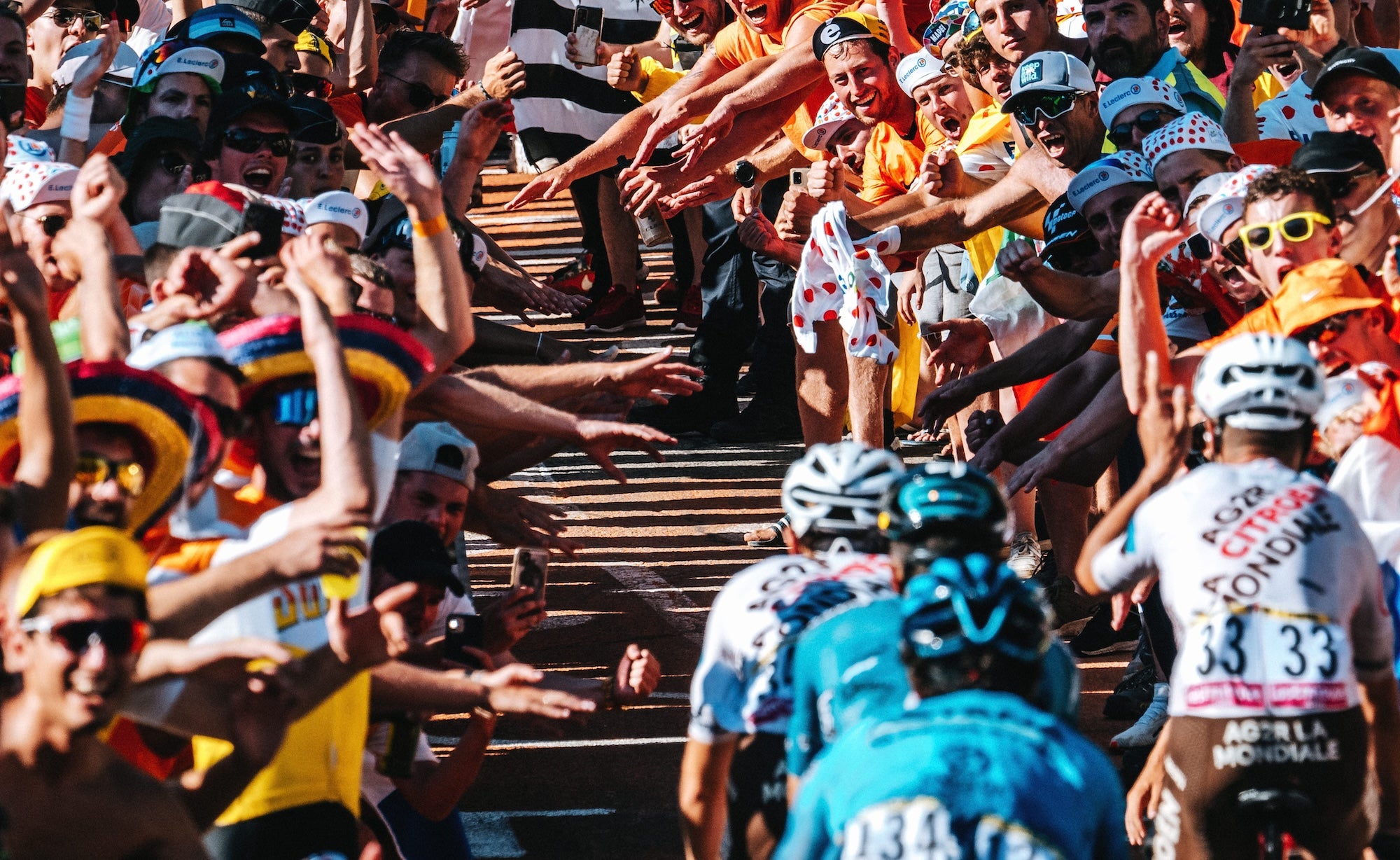
The peloton is bracing for mayhem on Alpe d'Huez for double stage finishes at the Tour de France. (Photo: Gruber Images)
The Tour de France peloton is bracing madness and pandemonium on Alpe d’Huez.
Fans started arriving days ago, and an estimated 500,000 have already poured into the ski resort for back-to-back stage finishes on the Tour’s most famous climb.
Overnight videos on social media showed fans partying deep into the night, and Visma-Lease a Bike boss Richard Plugge raised the alarm about something going wrong.
“There are now also a lot of people who think it’s carnival, who fill up with beer all day and at some point don’t know what they’re doing,” Plugge told In de Leiderstrui. “That’s really going to be a problem.”
Local officials closed road access to the climb on Thursday, but many fans had already arrived to snatch up the best viewing spots. Hotels are booked solid, and the few Airbnb spots were going for $2,500 a night.
ADVERTISEMENT
French phenom Paul Seixas knows he will be at the center of attention, but hopes his bid for a Tour podium won’t be derailed by the raucous crowds.
“It’s going to be incredible, but most of all, I hope I don’t crash on the climb because I think there will be a lot of spectators,” Seixas said at the finish line Thursday. “We’ve seen that it’s quite dangerous. I just hope everything goes well. After that, it’s my legs that will decide.”
Seixas has reason to be worried. In 1999, a fan taking a photo caused Giuseppe Guerini to crash when he was on the attack. The Italian scrambled back onto his bike and still held on to win.
‘Don’t do anything stupid’
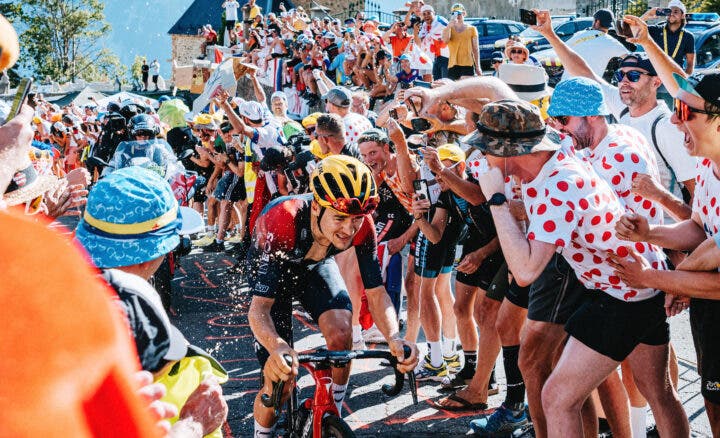
The anticipation is even greater because Alpe d’Huez is back on the men’s Tour for the first time since 2022. Demi Vollering won the stage in the Tour de France Femmes in 2024.
Tom Pidcock won that year’s stage out of a dramatic breakaway, with his famous downhill attack on the Col du Galibier going viral.
Tour officials posted a note on social media urging fans to behave.
ADVERTISEMENT
“Friday’s stage is eagerly attended, with many fans on the side of the road. Please follow the safety rules below,” it reads. “Do not touch the riders, do not use torches, keep your phone behind the barriers, don’t stand on the road, do no obstruct riders with flags, just don’t do anything stupid.”
The Alpe d’Huez stage has turned into one of Europe’s biggest parties, but at 13.8km at 8.1 percent, the climb isn’t actually that difficult compared to some of the Tour’s giants.
“The climb itself is nothing extraordinary, to be honest, but it is iconic,” American climber Sepp Kuss told Cyclism.Actu. “The number of fans makes it a finish where everybody wants to perform at their best, just because of the name.”
First up is Friday’s 127km 19th stage ending up the traditional approach peaking with the iconic 21 switchbacks.
Saturday’s 20th stage is even harder, with 5,500m of total climbing over three HC monsters, but only hits the final stretch of Alpe d’Huez after its approach from the Col du Sarenne.
‘We’ll see how extreme it is’
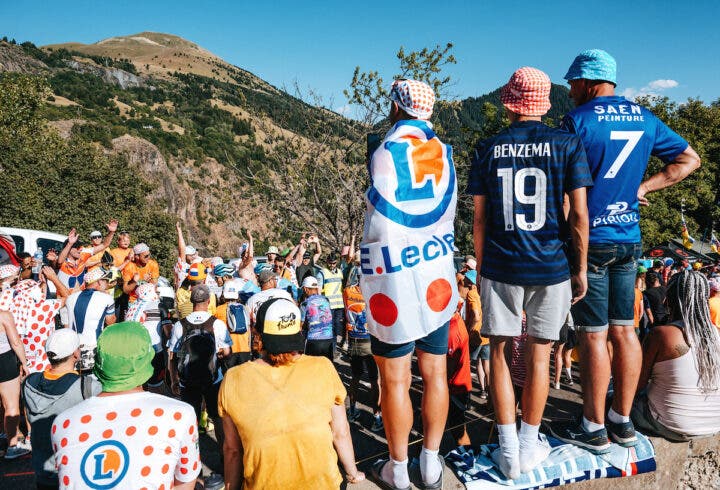
What makes Alpe d’Huez so mythic is the rock ‘n’ roll, stadium-like atmosphere, and masses of rowdy fans.
ADVERTISEMENT
Many are already packed in around the legendary Dutch Corner at turn seven. Riders languishing in the gruppetto can usually count on someone handing them a cold beer.
Some are worried that the party-like atmosphere could get out of control when riders pedal through a wall of fans, flags, noise, and the occasionally thrown beer.
Most fans behave, but some lean into road before jumping away at the last second, and riders are worried about getting knocked off their bikes or having a flag get tangled up in their chain.
“It’s a little scary when you see how narrow people sometimes make it. We’ll see how extreme it is,” second-place GC rider Remco Evenepoel told VTM. “Sometimes it can affect a bit if, for example, you’re stuck behind someone and can’t react.”
There are steeper, longer, and harder climbs in every Tour route, but none carry the prestige or mystique of Alpe d’Huez.
Pogačar wants to add his name
Fausto Coppi won the Tour’s first stage finish here in 1952 and the climb didn’t return until 1976, when it soon became known as “Dutch Mountain” after a string of Dutch winners.
ADVERTISEMENT
In 1986, Bernard Hinault and Greg LeMond famously crossed the finish line hand in hand, with the American gifting Hinault the win after a truce in their internal team struggle for yellow.
Each of the 21 bends is named after a stage winner, and everyone wants to add theirs.
Andrew Hampsten won in 1992 and remains the only official American winner after Lance Armstrong’s wins in 2001 (featuring “The Look”) and 2004 were stripped.
Marco Pantani won twice on the Alpe, and still holds the record for the fastest time 36:50 in 1995.
Pogačar is closing in on a record-tying fifth Tour title. This weekend he gets two chances to finally win atop Alpe d’Huez.
“It’s going to be fantastic. I hope nothing goes wrong, but we’ll see,” Pogačar said.