Updated March 9, 2026 02:59AM
Pogačar Is Already Flying. Why Vingegaard’s Giro Bet Is Starting to Make Sense
As the Visma star opens 2026 at Paris-Nice, his risky Giro-Tour strategy suddenly looks a lot more logical after Strade Bianche blowout.
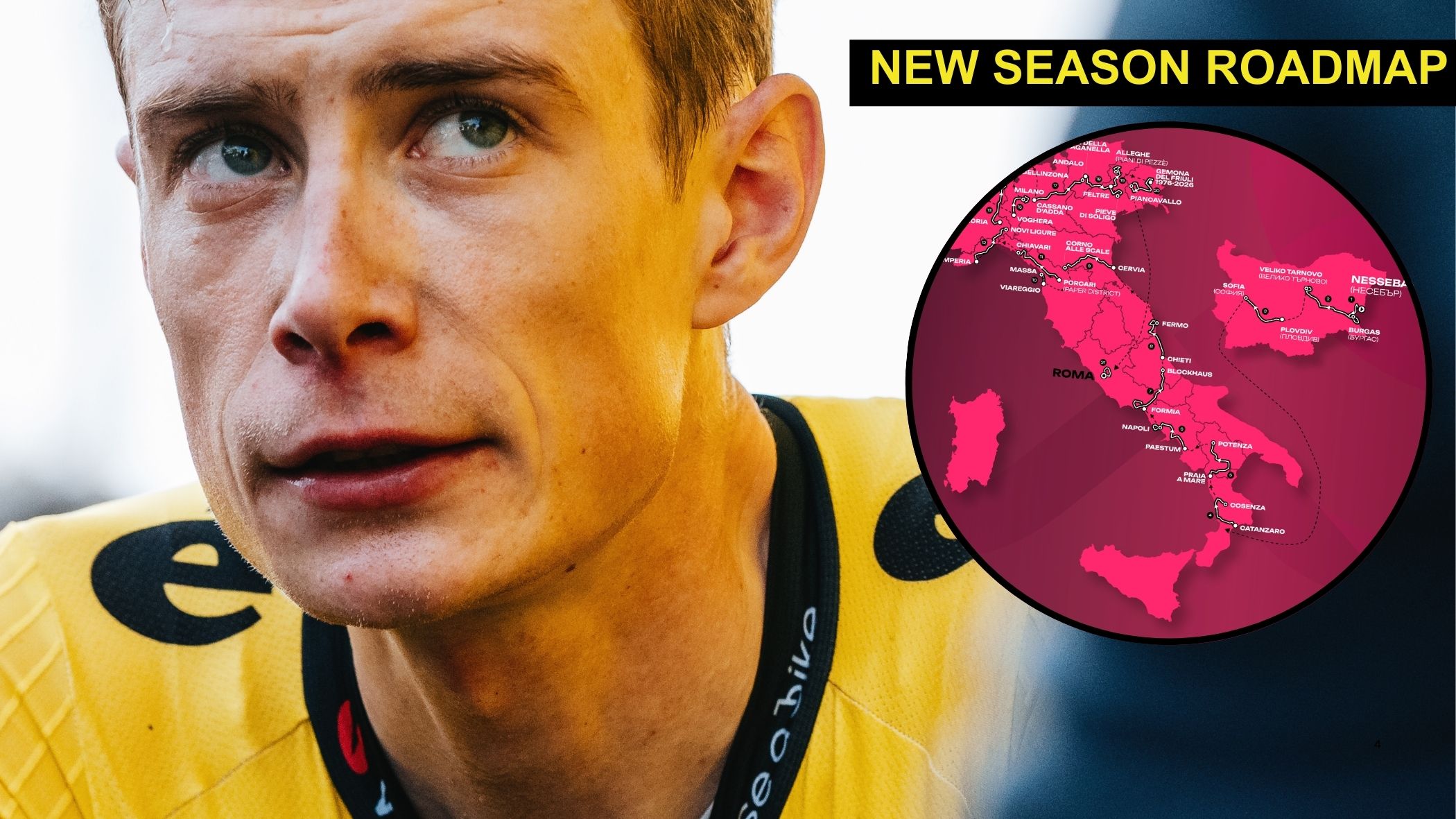
Vingegaard and his bet on the Giro is starting to make more sense. (Photo: Gruber Images)
As Tadej Pogačar disappeared into the dust hanging over the white roads of Tuscany, on the other side of the Alps was Jonas Vingegaard.
No one knows what the Dane was really thinking as Pogačar’s long-range attack at Strade Bianche turned into another solo demolition derby to open the 2026 season, but Vingegaard’s own campaign began Sunday at Paris-Nice with much less fanfare.
After a winter of discontent that included a crash, illness, and renewed questions about his decision to attempt the Giro-Tour double, Vingegaard — in trademark Danish cool — did not give much away.
“It was initially not the plan to be here, but I’m happy to be here. I’ve had a pretty decent preparation, but we’ll see in the race,” he told CyclingProNet. “There are a lot of uphill finishes and hard days for the GC, it will be interesting to see how it will be. We have a very strong team, and we are looking forward to racing here.”
Yet as the two-time Tour de France champion opens his season at the “Race to the Sun,” the Dane is abandoning the familiar Visma-Lease a Bike blueprint that has placed him first or second in every Tour since 2021.
Instead, he is rolling the dice on a radical new strategy that at first seemed crazy: racing the Giro d’Italia before targeting the Tour.
When it was rolled out in January, that bet seemed like a desperation move.
ADVERTISEMENT
But Vingegaard has his reasons, and he believes the Giro could unlock the edge he needs to challenge cycling’s dominant force.
And after what Pogačar just did at Strade Bianche, the logic behind that gamble suddenly might make more sense.
Why change now?
Ever since exploding onto the scene a half-decade ago, Vingegaard followed a near-identical road map to the Tour de France each summer.
Altitude camps, a carefully controlled spring calendar, and a buildup designed for peak power in July.
The strategy delivered remarkable consistency. Vingegaard won the Tour twice and stood on the podium every year since 2021, becoming the only rider capable of repeatedly pushing Pogačar to the limit in the high mountains.
But Pogačar evolved toward GOAT status, and it’s forcing Visma-Lease a Bike to rethink its approach to July.
In 2026, that means the unconventional bet of sending Vingegaard to the Giro before targeting the Tour.
“I wanted to try something different in the run-up to the Tour,” Vingegaard told Sporza before Paris-Nice started Sunday.
“I’ve always noticed that my absolute power is higher in a second grand tour,” he said. “So maybe that will make me reach a higher level in the Tour now.”
ADVERTISEMENT
Why now? It’s partly because they’ve been trying for the past 48 months clearly isn’t working.
And the team’s braintrust is hoping that a relatively “light” Giro route against a field of rivals Vingegaard has routinely dispatched could mean he’d exit May without burning too many matches.
So why not try something different? They’ve got nothing to lose, and perhaps the pink jersey to gain.
Not avoiding Pogačar
Inside Visma-Lease a Bike, the Giro-first strategy has been under discussion for months.
The team’s brain trust has been studying the data since the 2025 Tour ended. Unlike many in the peloton, Visma still believes it can solve the Pogačar puzzle. After all, they have done it twice before.
This is just a new take on the eternal problem.
Grischa Niermann, speaking during the team’s January training camp, made it clear that racing the Giro is not about avoiding Pogačar, but beating him.
ADVERTISEMENT
“We also definitely believe he can be better in the Tour than in the Giro. Our approach over the last five years has worked, because he has finished on the podium every year, but this is also a new approach,” Niermann told IDL.
The Giro-Tour double remains one of cycling’s most punishing challenges.
Until Pogačar pulled it off in 2024, it had been 25 years since Marco Pantani did what many believe was impossible in the benchmark in modern cycling.
But Visma’s data nerds crunched the numbers from Vingegaard’s Tour-Vuelta doubles from 2023 and again last year, when he won, and his power output was higher after putting three weeks in his legs.
They’re convinced that the data backs them up.
“Tadej proved two years ago that it’s possible, and we are convinced Jonas can do it too,” Niermann said. “We don’t have a guarantee, but we do have the data from his Tour-Vuelta combinations, and that makes us believe.”
Riders who attempt the double often arrive in July fatigued after three weeks of racing across Italy. And that’s assuming they don’t crash, fall ill, or abandon with nothing.
ADVERTISEMENT
Yet Visma believes the opposite could happen.
Rather than draining Vingegaard, the Giro could serve as the final conditioning block that gives him the extra gear he needs to match — and perhaps beat — Pogačar.
Unconventional? Yes.
But after watching the Slovenian rip apart the peloton at Strade Bianche, it’s obvious that sticking to the old formula isn’t going to work anyway.
ADVERTISEMENT
A turbulent winter
Vingegaard begins his campaign at Paris-Nice this week following a winter that included several disruptions that he hopes are now behind him.
A crash involving a following fan in Spain in January triggered a massive online debate about pros training on the open roads. That was followed by an illness that briefly interrupted his preparation, though he downplayed its impact.
“They weren’t that serious. It looked worse than it was,” he said of the crash. “The next day I was able to train again.”
ADVERTISEMENT
Illness forced adjustments to his training schedule, however, meaning he missed a planned season debut at the UAE Tour.
“After that fall, I did get sick, so I had to change my plans a bit. But that wasn’t such a big backlash,” he told Sporza. “My workouts went well, and I hope my form is good. I’m ready to race.”
Another significant shift came inside the team bus with the shock departure of longtime coach Tim Heemskerk after eight years.
Heemskerk played a key role in Vingegaard’s rise from unknown domestique to Tour champion.
“Tim is hard to replace. He is one of the best trainers out there,” he said. “I worked very well with Tim during that period. He was more than just my trainer. He is a good friend.
“His departure is very unfortunate, because I have always enjoyed working with him.”
Vingegaard will now work under Visma performance chief Mathieu Heijboer.
ADVERTISEMENT
Whether the disruptions prove to be more hurdles on what has often been a rocky road to July remains to be seen. Vingegaard has not had a clean run into the Tour since 2023.
Despite the risks that come with racing in May at the Giro, Vingegaard and Visma are betting the farm on it.
The Pogačar problem
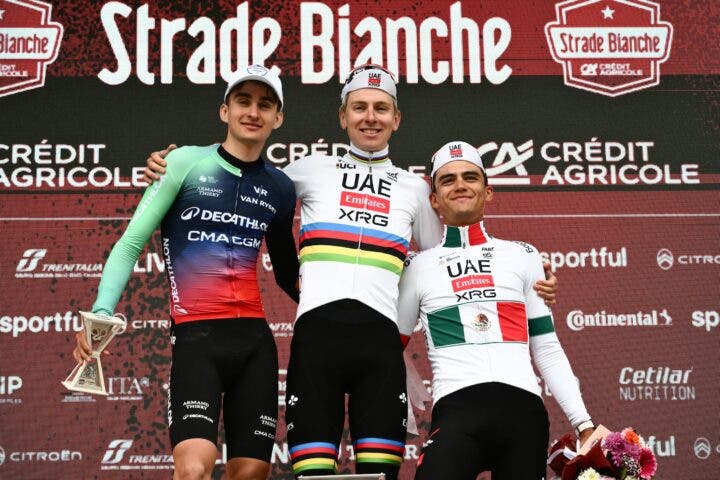
Ultimately, every calculation in modern stage racing leads back to the same question: how do you beat Tadej Pogačar?
Clearly, no one had the answer Saturday in Tuscany as the Slovenian attacked with 80km to go and won a record fourth time.
The UAE star continues to redefine what is possible in modern cycling, and his dominance is forcing Vingegaard and Visma to rethink how to win the Tour.
The Giro-Tour strategy shows the team is not standing still. The old formula is no longer enough.
“We keep aiming to win the Tour, the biggest race in the world. Beating Tadej in the Tour is the highest thing we can achieve, and that’s what we get up for every morning,” Niermann told IDL earlier this year.
“We were doing well, but ultimately not good enough. Now there’s a different route again, and we have to approach it differently.”
ADVERTISEMENT
So rather than retread what’s not working and get whipped by Pogačar again, changing things up might not be such a bad idea.
A new path toward July
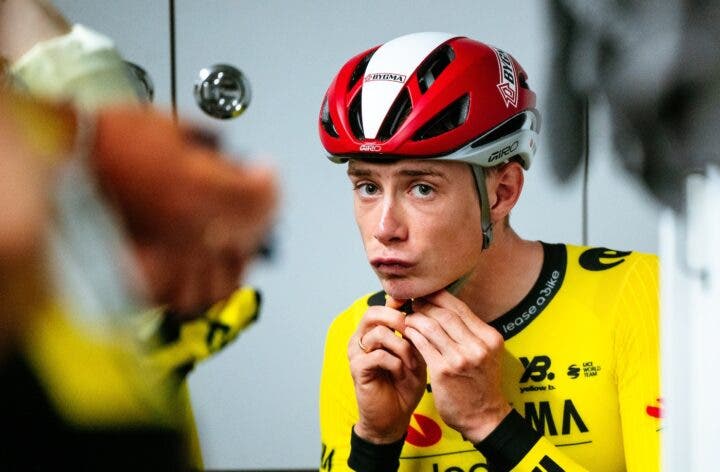
That plan begins quietly at Paris-Nice. Sunday’s opening sprint was just fine for Vingegaard, who’s looking deeper in the week for a chance to win.
The weeklong French stage race marks Vingegaard’s first test of the season before he builds toward the Giro and his brave new pathway toward cycling’s biggest prize.
He will race Volta a Catalunya later this month before disappearing from competition until the Giro. He will not face Pogačar again until July.
If the gamble pays off, the Giro could leave him sharper, stronger, and better prepared for the Tour.
If it fails, it risks leaving him beaten and battered against a rival who has already shown devastating early-season form, and coming away with nothing in both the Giro and Tour.
Despite the stakes, Vingegaard refuses to let Pogačar define his career.
ADVERTISEMENT
With three grand tour wins, he’s already the greatest Danish cyclist ever, and if it wasn’t for Pogačar, Vingegaard might be on the verge of the Tour’s five-win club instead.
“Pogacar unbeatable? Analysts can say what they want. I’m not doing that,” he told Sporza. “I focus on my own plan.”
There is another prize on the line as well.
A victory at the Giro would make Vingegaard just the eighth rider in cycling history to win all three grand tours. Chris Froome was the last in 2018.
“I really want to go for victory in the Giro,” Vingegaard said. “I have already won the Tour and the Vuelta. So, of course, the Giro is also a great motivation for me.
“Not many riders have done that, so it would be nice.”
And that is something not even Pogačar has done.