Updated May 14, 2026 10:37AM
She Called the Angliru Her Dream Climb. Then She Made History On It.
In an exclusive interview with Velo, Petra Stiasny tells her story of how she became the first woman to win on one of cycling's most feared and iconic climbs.
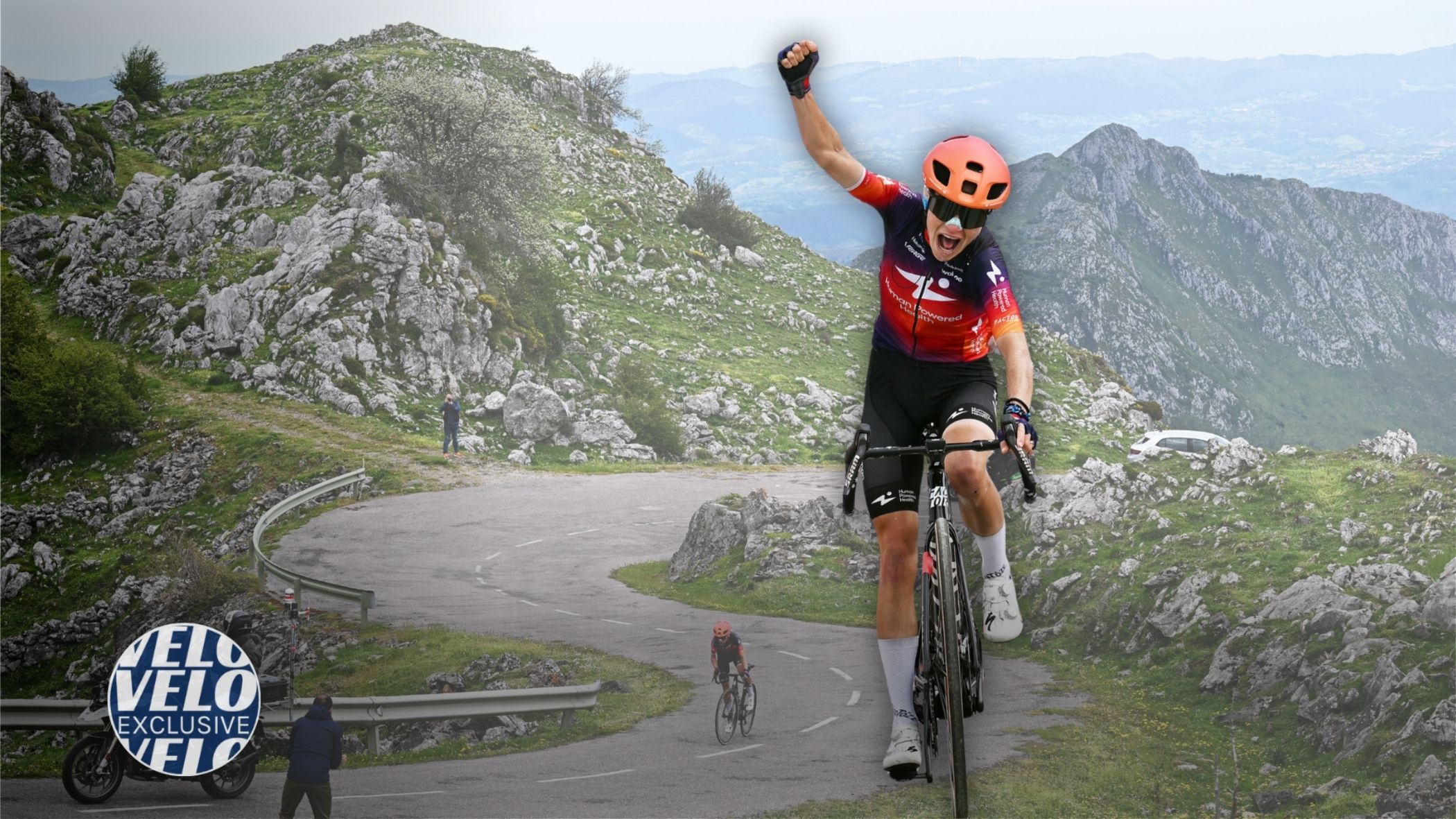
Petra Stiasny makes history atop the Alto de l'Angliru — the first woman ever to win a race on one of cycling's most feared climbs. (Photo: Getty Images)
Petra Stiasny — the first woman to conquer cycling’s most brutal climb up the Angliru — did not describe pain, survival, or suffering.
Instead, she found freedom.
For the first time in cycling history, women had raced up the punishing switchbacks of the Angliru, breaking through one of the sport’s last symbolic barriers on a climb synonymous with agony, collapse, and legend.
Five days after her historic victory, Stiasny still sounded stunned by her solo win.
“I still really cannot believe it,” Stiasny told Velo by telephone. “For sure it was a surprise for me.
“I really enjoyed it. It’s a type of climb I love, steep, hard, and I really felt free. I felt a freedom and joy in me that you don’t feel often in a race.”
ADVERTISEMENT
On stage 7 of the 2026 La Vuelta Femenina on May 9, the Human Powered Health rider powered to victory atop the Alto de l’Angliru, becoming the first woman ever to win a race on one of cycling’s most feared and mythologized climbs.
The Angliru’s debut marked another milestone for women’s cycling, bringing one of the sport’s most iconic climbs into the women’s grand tours alongside the Tour de France Femmes and Giro Women.
For Stiasny, 24, who had never won a pro race in Europe, it was also deeply personal, a mountain she had been dreaming about long before she ever raced it.
“I never rode it before. For me it was a dream climb. I know it from the history of cycling. It’s a super mystic place. All my idols won up there, like El Chava [José María Jiménez], Alberto Contador. For me it was special,” she told Velo.
“When I saw the men’s Vuelta last year, I thought it would be so nice if women got to do that in the Vuelta.”
La Vuelta organizers granted her wish.
ADVERTISEMENT
Stiasny — at a featherweight 5-foot-2 and 93lbs (42kg) — seemed destined for the fabled colossus of northern Spain.
‘We studied every detail’
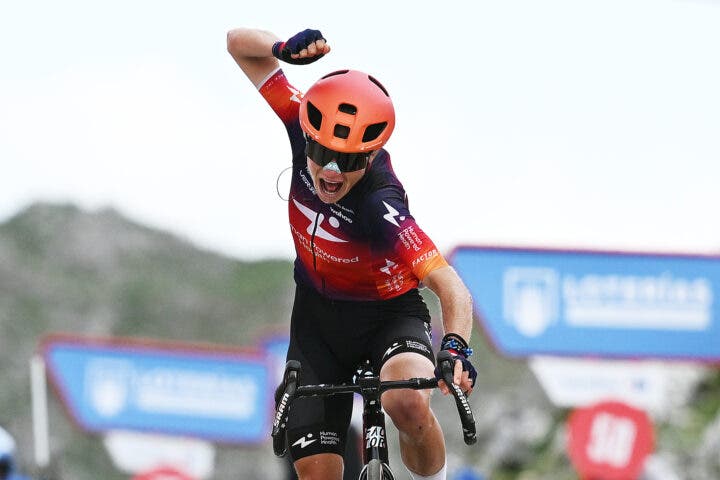
Freedom was an interesting choice of words for one of cycling’s most grueling and punishing climbs.
Debuted in 1999 as part of a new wave of “impossible climbs,” the Angliru stands apart as one of the sport’s ultimate challenges. Ever since, it’s been part of the lore of the men’s Vuelta a España.
And last week, the women took it on for the first time.
Stiasny, a former runner who found cycling after an injury during the COVID shutdown, had become obsessed with the climb months before the race.
“I studied the road book. We looked at it in detail, already months before,” she told Velo this week. “I was so looking forward to this stage.
“I was so interested I thought I would just like to come and ride it on holiday. It’s such a special climb that I really wanted to do,” she said. “It’s one of those bucket-list climbs.”
ADVERTISEMENT
This was no off-season jaunt. It was the queen stage to crown the winner of the 2026 La Vuelta Femenina, one of women’s cycling’s three grand tours.
By the morning of the stage, the nerves never came. Something special was happening.
“Compared to other races, I wasn’t nervous. I woke up and was super happy because today was finally the day,” she said. “I was looking so forward to that stage, to finally ride it.”
For a rider whose only other pro win came on a 9.5km climbing time trial at the Grand Prix Boquerón in El Salvador in 2025, the Angliru was an unlikely place to make history.
“I could feel I had good legs. I already felt it in the first part of the stage,” she said. “On the climb, I had really good sensations.”
Five years into her pro career, Stiasny was about to become the most talked-about climber in women’s cycling.
ADVERTISEMENT
How Stiasny rode to victory on the Angliru
In her first season with Human Powered Health, she wasn’t intimidated by either the mountain or her rivals. She felt empowered by the opportunity.
Racing against the likes of Pauline Ferrand Prévot, who would later fade on the Angliru, and Anna van der Breggen fills her with respect, not awe.
ADVERTISEMENT
“They are super big riders you respect them a lot, they’re the best ones who did so much, so to race with them and against them it’s always an honor for me.”
On roads as steep as the Angliru’s, tactics become brutally simple. Her climbing strengths soon proved decisive.
“On such a gradient, there is no draft, and that’s actually quite important,” she told Velo.
Stiasny followed the early accelerations before settling into her own rhythm, quietly confident, but also cautious about going into the red too early.
“I saw Gaia Realini go to the front on the first real steep parts, and I went with her, and I took my pace at the front. Because you don’t get a draft, I knew I could do what I wanted.”
Later, when eventual GC winner Paula Blasi and Van der Breggen pushed ahead for the red jersey battle, she resisted the temptation to follow too soon.
ADVERTISEMENT
“I felt quickly that if I continued like this I would blow up later, so I continued at my own pace,” she recounted to Velo.
One by one, riders began to crack. She kept feeling good — as good as you can on a nasty climb with 25 percent ramps — and started to dare to believe as she inched up the gruesome Cueña les Cabres sector.
“I kept at my pace and I came back to them,” she said. “First I came to Marion (Bunel, later third overall) and to Paula, and I saw them suffering quite hard.”
Then came the decisive move. Aboard her Factor O2 VAM climbing bike, she passed Blasi with just over two kilometers to race.
“At the start of the steepest section, I came up to Blasi and took the inside on the corner to pass her,” she said. “Then I knew the hardest part was still to come.”
Stiasny was suddenly off the front alone on the hardest, most notorious climb in Spain.
ADVERTISEMENT
The first women’s race up the Angliru
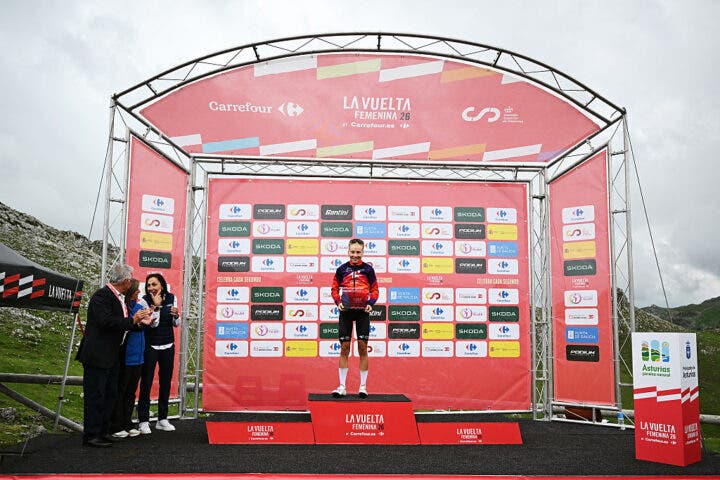
Stiasny understood immediately she could not wait for the finish. Despite being one of Europe’s hardest climbs, there’s actually a short, quick downhill run to the line.
“I knew I had to make the difference on the steepest part, because if I arrived with Blasi, I would lose the sprint,” she told Velo. “I had to be on top alone if I wanted to win.”
On a climb as steep as the Angliru, even a tiny separation can become a chasm impossible to close. She kept tightening the screws.
ADVERTISEMENT
“On climbs this steep, just 10 meters is already a big gap,” she said. “You cannot just close it like that.”
A week later, she still cannot believe it.
“I always aim for the best possible result, but to be honest, I didn’t think I could really win it,” she said. “I believed I could do a good result or a top 10, not winning it.”
‘It was a dance’
Writing on social media, she captured the feeling in a single line: “It was not an effort, it was a dance.”
The deeper she climbed up the brutal steeps, the better she seemed to feel.
“You don’t often have days where everything comes together — good legs, good feeling, a climb perfect for you. Maybe once or twice in a lifetime,” she said. “It was incredible. It was not a pain cave.”
Only in the final meters did fear begin to creep in.
ADVERTISEMENT
“I only felt that I had won when I crossed the finish line,” she said. “I felt that [Blasi] was just behind me and I was afraid she would catch me.”
Despite her compact climber’s frame, Stiasny unleashed a thunderous roar when she crossed the line alone atop the Angliru.
Not only was it the biggest win of her career, it also delivered the first grand tour victory for Human Powered Health, the U.S.-registered WorldTour team that’s been chasing that dream longer than she has.
This winter, Stiasny visited the Human Powered Health Performance Lab in Wellesley, Massachusetts, where she underwent three days of physiological testing. The team’s performance staff used that data all spring to shape her preparation for the Angliru.
“It means a lot for the team. It’s the first victory in a grand tour,” she said. “They support me really well. I feel honored. It’s a victory from one person, but everyone works for it — mechanics, physio, the bus driver, they all stand behind it. There is such a big team behind this victory.”
ADVERTISEMENT
The triumph also capped an unlikely rise for a rider who only came to cycling during COVID, after injuries derailed her running career and swimming pools closed during lockdowns.
“I started cycling pretty late, during COVID, and I didn’t grow up with cycling,” she said.
“I cannot describe it. It was everything coming together. I do not have the words.”
She grew up idolizing the riders who won on the Angliru. Now Petra Stiasny is one of them.