Published June 24, 2026 03:57AM
Pogačar Is Stronger Than Ever in Time for the Tour de France—The Power Numbers Prove It
The four-time Tour champion just put in some performances at the Tour de Suisse that will have his rivals more worried than ever.
(Photo: Harold Cunningham / AFP via Getty Images)
Rumor has it that Tadej Pogačar is stronger than ever.
The four-time Tour de France champion has only raced 16 days this year, but he has won 11 of those races/stages, taking two GCs and two points jerseys along the way. The only race he entered but didn’t win overall was Paris-Roubaix, where he lost the sprint to Wout van Aert in the velodrome.
Many of his early season races were flat or moderately hilly — Paris-Roubaix and Milan-San Remo hardly had any climbing, while the longest hills of the Ronde van Vlaanderen and Liège-Bastogne-Liège lasted only a few minutes.
ADVERTISEMENT
As Pogačar prepares for the Tour, he is getting ready to put out 30-40 minutes of power at a time. Long steady grades will be present throughout the Tour, and those are the kinds of climbs where Pogačar has been beaten in the past. So when the world champion lined up for the Tour de Suisse for the first time ever, us fans were in for a treat.
In the first stage of five, Pogačar couldn’t help himself but to attack. He got a gap with 72km to go and decided to put his head down and go for glory. The Slovenian made it look easy, putting more than two minutes into second place and four minutes into the remnants of the peloton. In reality, the fight for the GC was already over.
But what had Pogačar shown with his impressive solo raid? A normalized power of 5.7w/kg for nearly two hours.
Pogačar – Stage 1 Solo Win
- Time: 1hr 50min
- Average Power: 330w
- Normalized Power: 370w
Pogačar hardly held back on stage 2, attacking on a punchy climb near the finish and nearly catching the breakaway of the day. Only Mathias Vacek was able to follow, a sign that he is one to keep an eye on for the rest of the season. The chasers came within five seconds of the leaders, but Romain Grégoire won stage 2 from the breakaway.
ADVERTISEMENT
After Jhonatan Narváez won from the breakaway on stage 3, it was time for the TT test in Aarburg. The 23.7km course had only 202 meters of climbing, which meant that Pogačar might have a hard time winning the stage against the larger time trial riders. Tim Wellens, Vacek, Tobias Foss, and Mathieu van der Poel all posted incredible times with average speeds over 53 kph, but then it was Pogačar’s turn to show us his best.
Velon posted Pogačar’s power data from the effort, and I don’t think I’ve ever seen a w/kg output this high on a time trial bike. The Slovenian was pushing nearly 7w/kg in the time trial position, averaging 53.4 kph and beating Van der Poel by less than a tenth of a second for the stage win.
If there was any doubt that Pogačar was lacking power on the flat, this result erased exactly that.
Pogačar blasts off in ‘queen stage’
Now it was time for the moment we’d all been waiting for. After four days of punchy efforts, last-chance breakaways, and a blitzing time trial, the mountains were calling for stage 5 of the Tour de Suisse.
ADVERTISEMENT
The 150km route included more than 4,400 meters of climbing and a summit finish at Villars-sur-Ollon. As if the profile wasn’t hard enough, the average temperature of the stage was nearly 30°C, and likely higher on the final climb.
Up and down, up and down, up and down the peloton went for 138 kilometers. The breakaway was whittled down to a handful of riders on the penultimate climb, and then it was time for UAE Emirates-XRG to take over. The team lined out the peloton for their leader, and it wasn’t long before the yellow jersey launched his winning move.
The climb had hardly just begun, but Pogačar was already stamping on the pedals with 8.5km to go. Pushing nearly 600w, the world champion looked powerful and confident on the bike. This wasn’t an attempt to drop his rivals — this was an uphill time trial against himself. Pogačar already had a four-minute lead in the GC, so he didn’t even need to do this. But as the kilometers ticked by, you could tell that he was riding all-out.
ADVERTISEMENT
One of the few signs of fatigue began seeping through Pogačar’s body as he closed down Lenny Martinez with 1km to go. The Slovenian’s head began bobbing up and down, ever so slightly, rather than side-to-side as it does when he is in complete control of his effort. This effort was a test, a sign of Pogačar’s shape before the Tour de France. The results were off the charts.
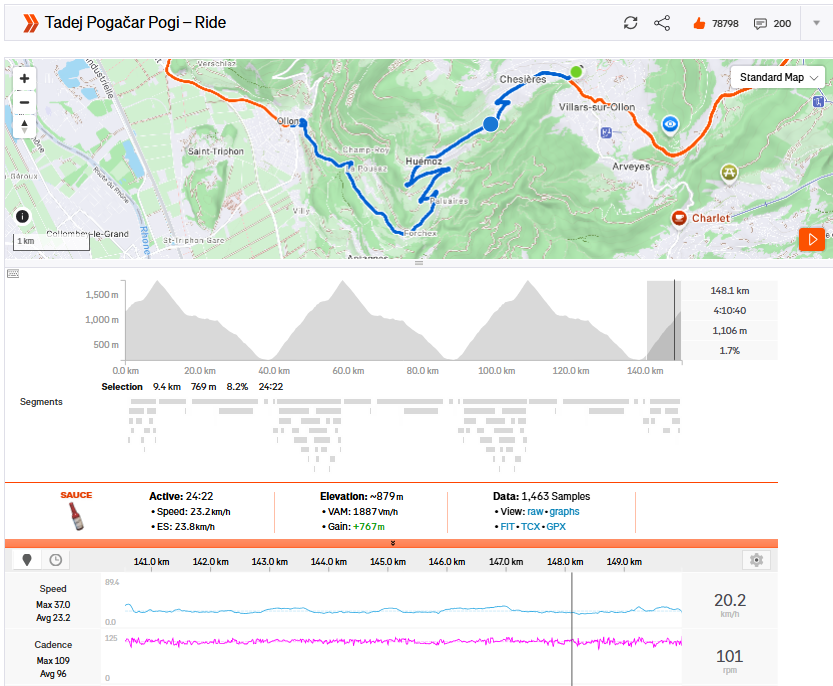
Pogačar – Climb to Villars-sur-Ollon
- Time: 24:22
- Estimated Average Power: 7.2w/kg
- VAM: 1,887 Vm/h
While the numbers are certainly impressive, they are even more important at this time of year. With the Tour de France only a few weeks away, a performance like this is indicative of the speed we’ll see from Pogačar at the Tour.
Pogačar didn’t just break the climbing record on Villars-sur-Ollon, he did one of his best climbing performances of all-time. The closest comparison from last year’s Tour de France is the stage 13 time trial on Peyragudes.
In a completely fresh effort, Pogačar did an estimated 7.5w/kg for 17 minutes, while Jonas Vingegaard was the second-best rider on the day, pushing an estimated 7.3w/kg for just under 18 minutes.
ADVERTISEMENT
At the Tour de Suisse, Pogačar produced a similar climbing performance. But this time, instead of a fresh time trial, he did it after 3,000 kJs in the heat of a 150km road stage. Velon posted the data from Pogačar’s attack, a ridiculous output of 470w for the final 3.9km of the climb. At his Tour de France weight of 65kg, that is just over 7.2w/kg.
Power Analysis data courtesy of Strava
Strava sauce extension
Riders: Tadej Pogačar