Updated July 19, 2026 04:24PM
Tadej Pogačar Claims Doping Officials Were Outside The Rules
Tour de France leader reflects on ‘strange’ testing and accepts overnight anti-doping vists are necessary to prove he is clean.
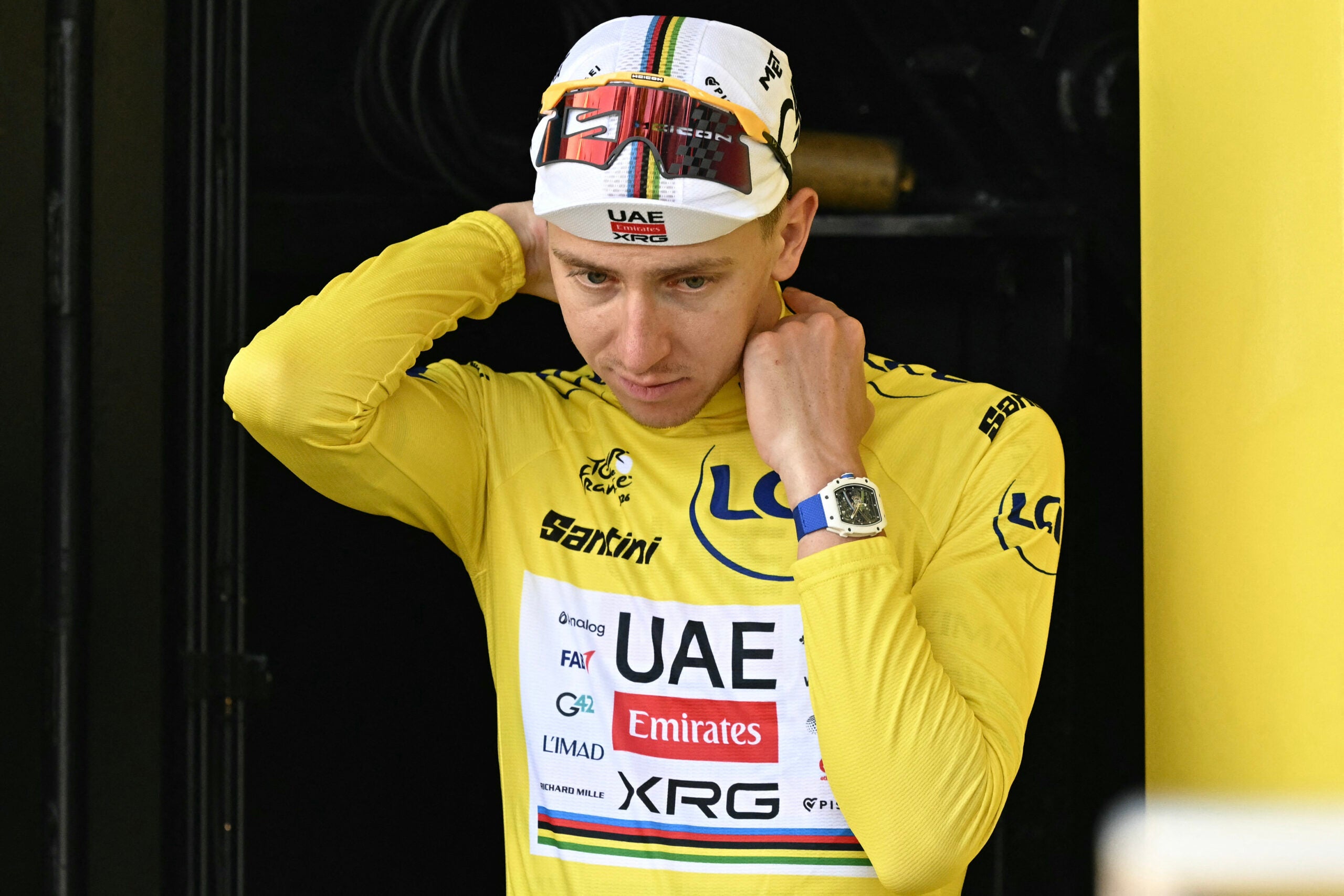
UAE Team Emirates - XRG's Slovenian rider Tadej Pogacar celebrates on the podium with the overall leader's yellow jersey after the 9th stage of the 113th edition of the Tour de France cycling race, 154,6 km between Malemort and Ussel in central France, on July 12, 2026. (Photo by Loic VENANCE / AFP via Getty Images) (Photo: AFP via Getty Images)
Hours after being woken at 5 a.m. to be tested by the International Testing Agency (ITA), the Tour de France leader Tadej Pogačar claimed after stage 15 that testers had been “outside” the rules earlier this year.
In his post-race press conference, the Team UAE Emirates-XRG mega-star talked at length about how it has been “very, very strange with testing in general”.
He has been seeing anti-doping officials “doing different things” in the first four months of 2026.
Testers ‘out of the rules’ taking blood so soon after Strade Bianche win
Pogačar said that after winning Strade Bianche in March and doing his press conference, he came to the race’s anti-doping control and waited an hour to do a blood test.
“The rule was before April of [20]26, after heat sauna session or hard training session, there is a two hours window that you cannot take blood and test [it],” Pogačar claimed.
“I think this was out of the rules because I think Strade Bianche was before April, if I remember. Yeah, it was in March. Then from April on, they change the rule that we can be tested with a blood test one hour after the stage.
ADVERTISEMENT
“It happened also here in the Tour, they test now after some stages, also with blood so you need to wait [for] one hour after the stage.”
Pogačar: Out-of-hours testing necessary to prove we are clean
Pogačar was surprised to be woken up at the crack of dawn for a test, albeit three hours later than Jonas Vingegaard.
Regarding his 5 a.m. test on Sunday, Pogačar said that the DCOs [doping control officers] and the doctor that woke him were “really nice, they apologized. Because it’s not their fault they come at five in the morning.”
“And I asked because I also thought the window is from 11pm to 6am that they cannot come. But they replied to me it’s a night control.”
Stage winners and leaders of the Tour’s classifications are routinely tested after each stage, but the International Testing Agency also conducts targeted, unannounced controls at team hotels throughout the race.
ADVERTISEMENT
Amid condemnation from other top riders about overnight testing which can interfere with a a grand tour challenger’s recovery, Pogačar was tolerant: “It’s just a little bit strange, but I accept it. If this is necessary to still prove that we are riding clean … and I commit to this.”
“But it’s a bit shit when you sleep four hours one day in the middle of a three-week Tour. If he was tested at two in the morning, probably Jonas even slept less than four hours,” he said, coming towards the end of his extraordinary five-minute answer to a press conference question from Jeremy Whittle of The Guardian.
It is all part of what Pogačar perceives as testers “doing different things. For example, I was counting how many controls I had at home since first of January until the end of Classics.
“When I was home, I was already waking up every day at six to go check the doorbell, if somebody was ringing, because I had so many visits.
“I didn’t want to go for dinner or whatever, to the supermarket even, because they were coming at random hours, not in the hour’s slot [I gave].”
Testing agency comment on overnight testing
Velo reached out for comment to the International Testing Agency (ITA), the organization that runs anti-doping for the sport’s governing body, the UCI. This was their message:
“The ITA is conscious that night-time testing may be disruptive to riders’ rest and recovery. Due consideration has therefore been given to minimize as much as possible the impact testing activities have on riders.
“However, the ITA, on behalf of the UCI, has the responsibility to ensure the effectiveness of the cycling anti-doping program and the integrity of cycling races.
ADVERTISEMENT
“As such, effective testing must, in limited and justified circumstances, be capable to occur outside standard daytime hours. All testing activities conducted at the Tour de France and at any other international events, including decisions as to the specific timing of such tests, are carried out in accordance with the ITA’s testing strategy and subject to the safeguards established under the World Anti-Doping Code, the UCI Anti-Doping Rules and French law, with due consideration for riders’ welfare, equity and fundamental rights.”