Updated July 25, 2026 07:23AM
Power Analysis: How Pogačar Wrote More History with Record-Breaking Climb of Alpe d'Huez
Tadej Pogačar beat Marco Pantani's record on stage 19 of the Tour de France with a blazing solo attack to add another bucket-list record to his palmarès.
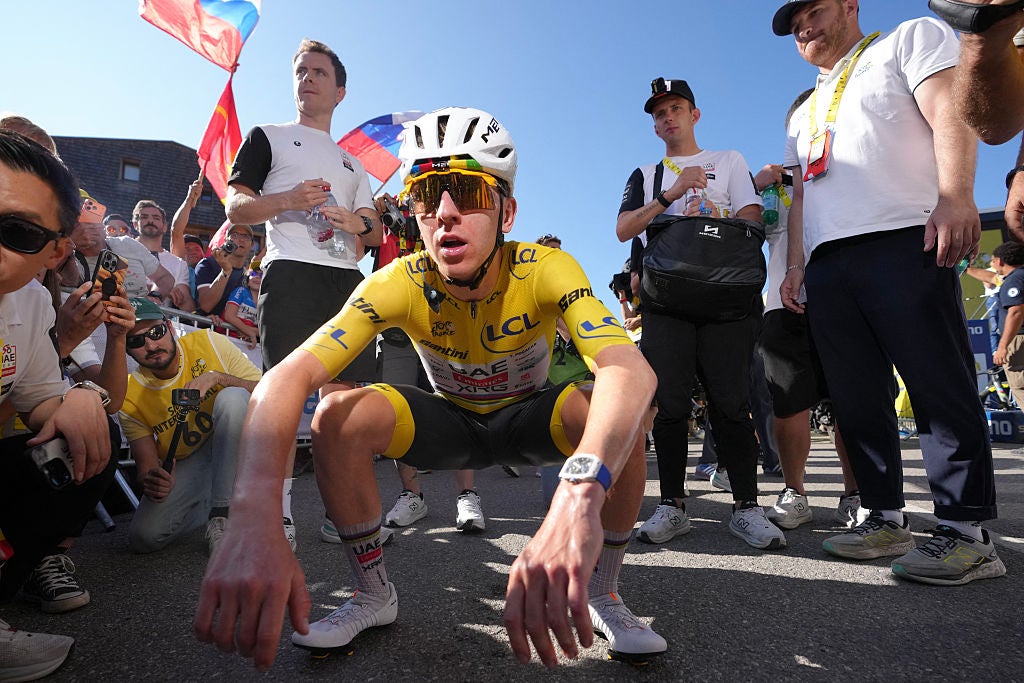
Pogačar broke Pantani's ancient Alpe d'Huez record on stage 19 of the Tour de France to put an excalamation point on his fifth Tour de France title. (Photo: Thibault Camus / POOL / AFP via Getty Images)
There is a reason that you feel a certain way about Tadej Pogačar. He is special in every sense of the word. There was no reason for him to attack with 12km to go on Alpe d’Huez. It was Stage 19 of the Tour de France, and Pogačar was leading the GC by nearly five minutes. He had been the strongest rider in every stage apart from the individual time trial, and there was illness making its way through UAE Team Emirates-XRG.
Many of his teammates had been crawling through the previous few stages. Brandon McNulty couldn’t even finish the other day because he was so sick. Teammates ate and slept in separate rooms, not the ideal team atmosphere you want to have before the hardest stages of the Tour.
Stage 19 of the Tour de France: Racing on tired legs
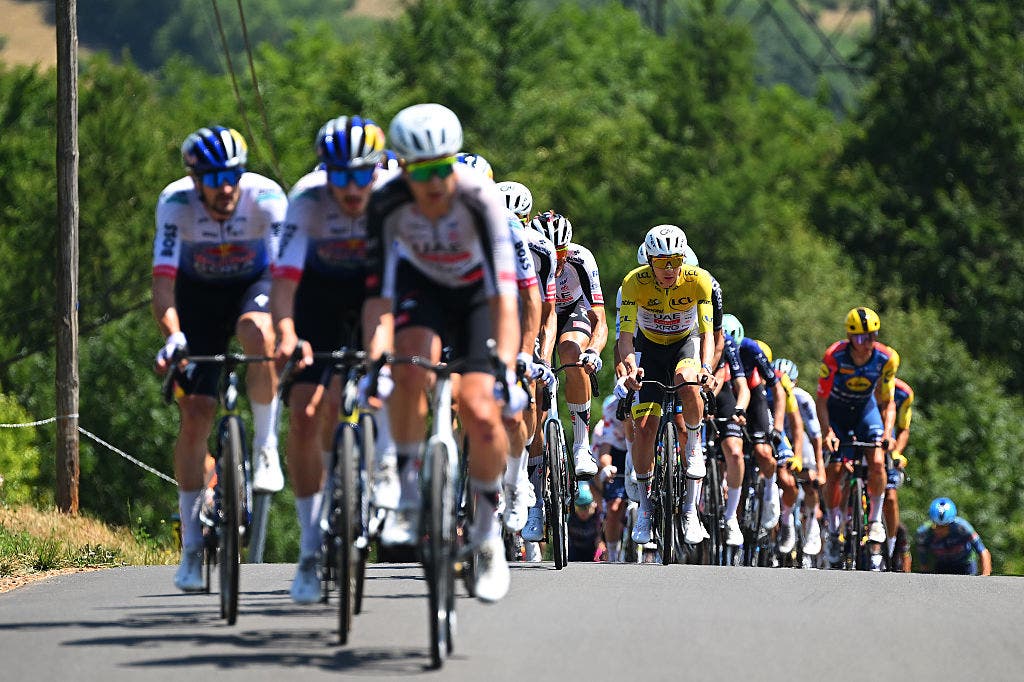
When the early break went at the beginning of Stage 19, it looked like their stage to lose. All the breakaway favorites were represented including Richard Carapaz, Lenny Martinez, and 4-5 riders from teams like Visma-Lease a Bike and Lidl Trek. UAE Team Emirates-XRG had very little fire power to chase in the peloton, but Adam Yates had made his way into the break despite looking like a ghost on a bike 48 hours ago. That breakaway move would turn out to be crucial for the finale. But first, we had 115km of racing to get through.
Stage 19 was far from the hardest stage of this year’s Tour, especially before the final climb up Alpe d’Huez. That doesn’t suggest that riders had fresh legs; racing had been full gas for multiple days, including a lumpy “sprint” stage two days ago won by Jasper Philipsen.
ADVERTISEMENT
The first portion of Stage 19 was a tale of two races: one in the breakaway and one in the peloton. The breakaway was racing to the bottom of Alpe d’Huez, looking to gain as big of an advantage as possible. But riders in the breakaway also wanted to drop each other – just wait till we discuss what happened on the final climb.
In the peloton, the pace was tough but manageable for the GC contenders. Most arrived at the base of the Alpe with as good of legs as you can have on the 19th stage of a Grand Tour. When the breakaway crossed the KOM banner to begin Alpe d’Huez, one of two stopwatches started. First, we needed to know the breakaway’s advantage on the peloton. The second stopwatch would start ticking once Tadej Pogačar began the ascent. If there was anyone that was going to break Marco Pantani’s climbing record that has stood for more than 30 years, it was going to be Tadej Pogačar.
The breakaway started climbing Alpe d’Huez about three and a half minutes ahead of the peloton. It was a gap that wasn’t insurmountable for a hard-charging Pogačar. But there were also a few riders in the break that are among the best climbers in the world: Carapaz, Martinez, and Sepp Kuss, to name a few.
ADVERTISEMENT
Attacks began almost immediately, both in the breakaway and what was left of the peloton. Carapaz began launching his trademark: a 30-second out of the saddle sprint that is completely unsustainable on a 13km climb. But as we saw in Stage 18, the strategy sometimes works, demoralizing his competitors as the Ecuadorian settles into a much more manageable tempo. Unfortunately for Carapaz, there were two riders from the breakaway that could match his accelerations for the majority of the climb. Kuss and Martinez were able to follow Carapaz until the last few kilometers, when the Ecuadorian finally broke away from Kuss. But there was another story unfolding behind.
Pogačar makes record-breaking attack
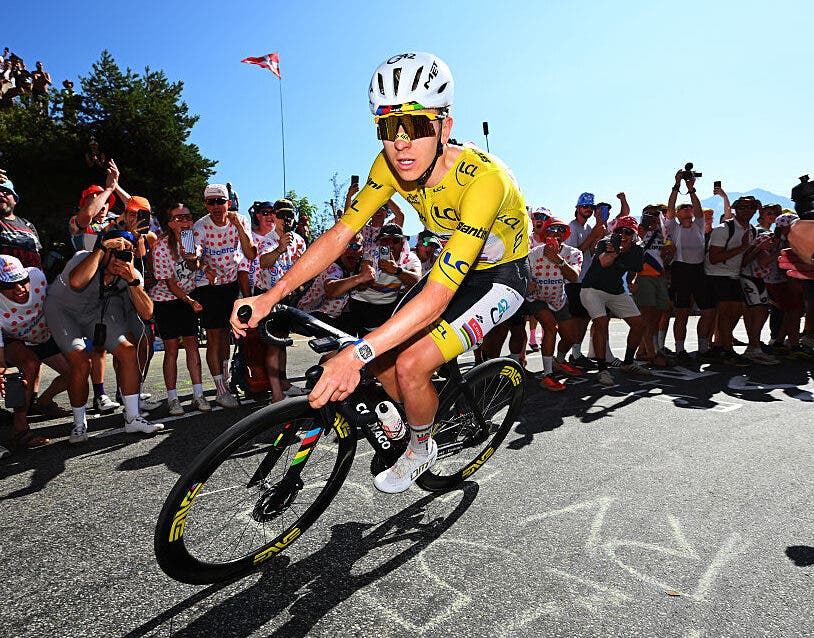
With 12km to go on Alpe d’Huez, Pogačar dropped the GC competitors off his wheel. We’re not sure anyone tried to follow him. Indeed, this was one kilometer into a 13km climb with an average gradient over 8%. It was extremely risky to go over your limit so early in the climb, but that’s exactly what Pogačar forced them to do. The yellow jersey didn’t look back as he powered away in the saddle. By our estimations, the GC group was pushing around 400-450w (6-6.5w/kg) for the majority of the climb. The way in which Pogačar got a gap, and how quickly he put 90 seconds into the GC group, he was probably putting out 7.1-7.3w/kg for the first part of the climb.
Eventually, Pogačar caught up to his teammate, Yates, who had made a miraculous recovery from looking on the verge of hospitalization two days ago. The Brit pulled for Pogačar, not to take on his GC rivals, but to catch the break, win the stage, and set the fastest time ever on Alpe d’Huez. The plan was clear: ride as quickly as possible from bottom to top. Pogačar soon left Yates behind and began closing in on the breakaway. This is the point at which Carapaz and Martinez were beginning to drop Kuss. The yellow jersey overtook the American and set his sights on the leaders with a few km remaining.
ADVERTISEMENT
With 2km to go, Pogačar tried to drop Carapaz and Martinez. But the diminutive duo clung to Pogačar’s wheel, and suddenly, the stage win was not a foregone conclusion. The climb flattened out in the final 1.5km, the Alpe d’Huez Strava segment ending a few minutes prior. But as the road flattened, Pogačar put in another seated acceleration, this one the fiercest of them all. For the first time on the climb, we saw a grimace on Pogačar’s face. The yellow jersey squeezed and squeezed, and eventually Carapaz and Martinez caved. Pogačar rode onto the stage win, securing the yellow jersey and Alpe d’Huez record with a classic Pogačar performance.
Pogačar – Alpe d’Huez Climbing Record
Time: 35:27
Estimated Power: ~6.9w/kg
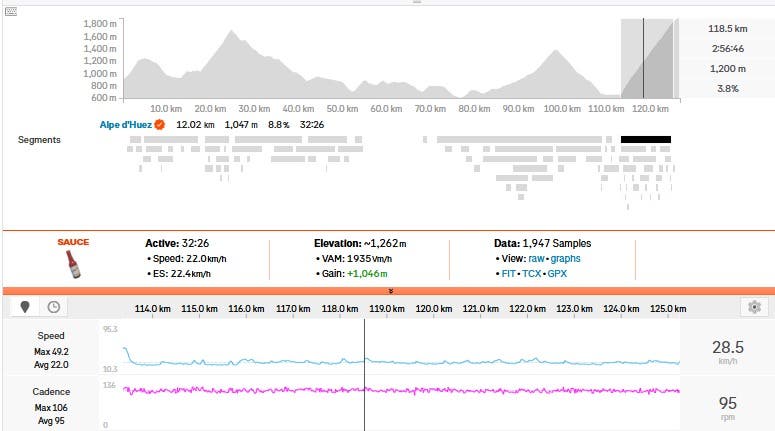
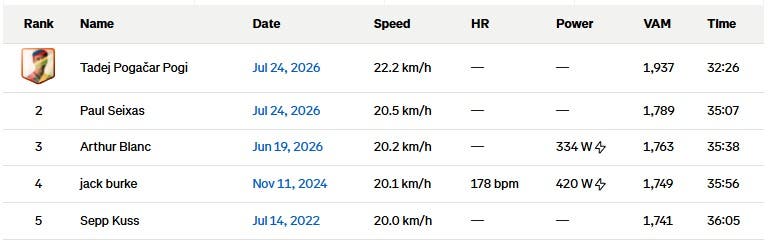
Alpe d’Huez Strava KOM: 32:26 at ~7w/kg
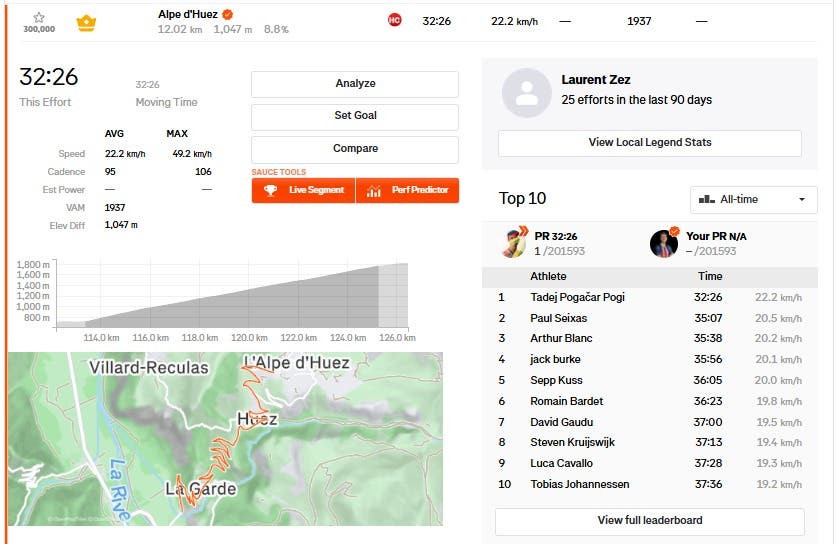
Pogačar didn’t just set the Alpe d’Huez record, he beat Pantani’s time by more than a minute. No one had come close in decades, and many actually doubted Pogačar’s chances. He came into Stage 19 with little motivation left for this year’s Tour. The yellow jersey was basically sewn up, and half of his teammates were sick, injured, or out of the race. Once his #1 rival Jonas Vingegaard crashed out of the Tour, you could see the life drain from Pogačar’s face. Sometimes, it’s hard to tell if he wants to be here or not, wearing the yellow jersey and setting all-time climbing records. But what no one can doubt is his capabilities as a cyclist. Tadej Pogačar can do anything, including crushing climbing records from cycling’s darkest era.
ADVERTISEMENT
With another finish on Alpe d’Huez in Stage 20, albeit from a much different and easier side, could we see Pogačar go for the win again? Or maybe we will see Pogačar work for his teammate, Isaac Del Toro who put a few seconds into Paul Seixas today to gain some confidence in fighting for the GC podium and white jersey of best young rider.
Best ever? Up there with Plateau de Beille
At the end of the day, we cannot confidently say that this is Pogačar’s best performance ever. The Slovenian did a slightly better performance on Plateau de Beille in 2024, and that was at the end of a hot 185km stage. The pace had also been on all day, whereas this year’s 128km stage to Alpe d’Huez was a bit easier. Then again, Pogačar basically did a time trial up Alpe d’Huez. He didn’t have a rival pushing him to his limit. Only in the final kilometer did Pogačar really go all-in to drop another rider. Is this the best Tadej Pogačar has ever been? If not, it is certainly close.