Updated July 25, 2026 12:50PM
All of Unsafe Alpe D’Huez Should Have Barriers: Peloton Vents Shock and Frustration
When awe meets awful risk: German sprinter almost pushed off bike as peloton veterans suggest safe solutions to Alpe anarchy.
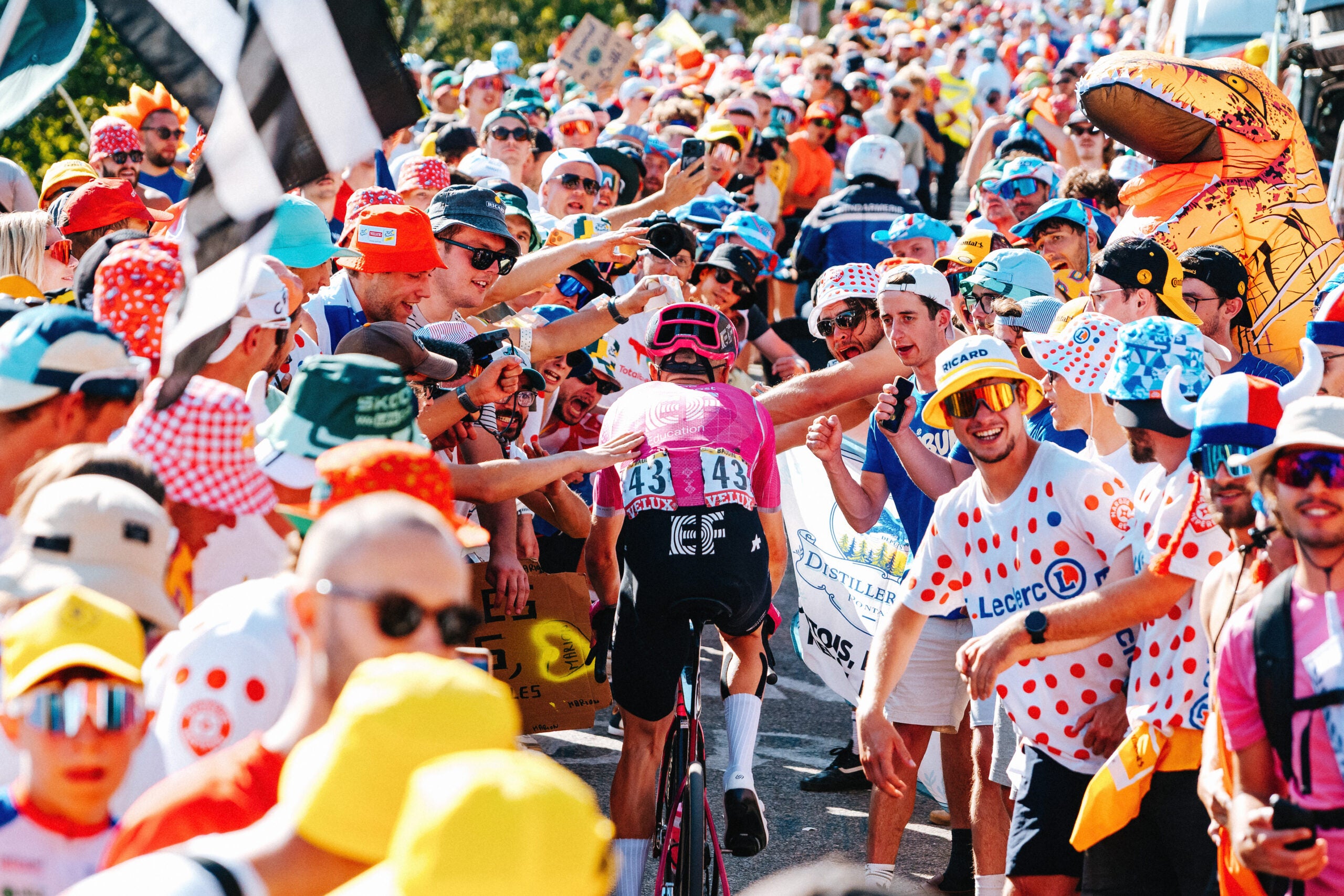
Alex Baudin rides through the crowd on Alpe d'Huez. (Photo: Gruber Images) (Photo: Gruber Images)
Every time the Tour de France comes up Alpe d’Huez, it is walking a tightrope between the reward of entertaining sport and the risk of serious rider injury.
As Tadej Pogačar raced to victory, a bloodied Einer Rubio abandoned the race with 20 stitches in his face after riding into the back of a team car. It was seemingly forced to brake for a fallen spectator.
There were more bad news stories from stage 19‘s centerpiece. Remco Evenepoel complained of accelerations shut down by race motorbike traffic threading the needle through the tunnel of fans.
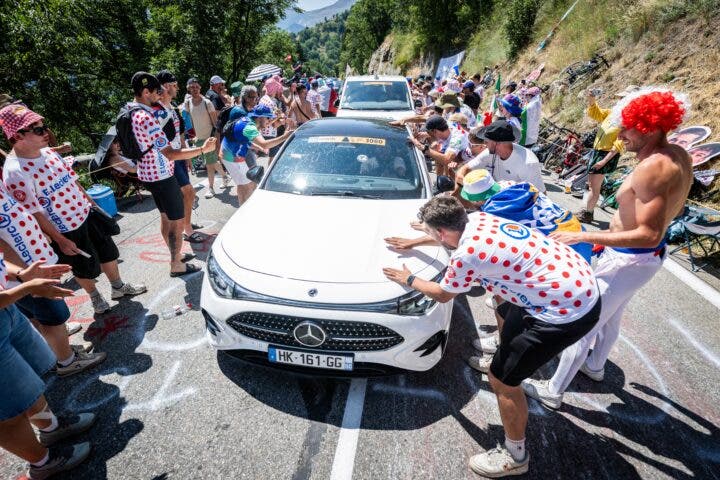
Contenders having to brake on the way up, forced to slow and stop behind race traffic or stationary team cars. Hundreds of close calls and fans with feet run over. Spectators climbing all over accredited vehicles.
Alpe d’Huez might have resonated with the approximate 500,000 on the legendary mountain and the wider watching cycling world, but many of those riding up in the peloton experienced both awe and safety concerns.
ADVERTISEMENT
From the front to the back of the race, competitors experienced delays, including Jayco Alula sprinter Pascal Ackermann.
German sprinter ‘pushed’ off the bike
Ackermann explained to Velo that as he rode past a fan, he turned back into his path: “I don’t know if it was on purpose or he just wanted to move back because there were a lot of spectators around but he pushed me off the bike – nearly.
“I was not crashing, but I was quite shocked and could just about stay on the bike.”
The German sprinter sees improving Alpe d’Huez safety as a problem be separated into two parts: the GC riders who need space and to see where to ride and those in the back enjoying the atmosphere.
“I think it was a super nice experience and atmosphere with all the crowds cheering,” Ackermann added. “I had two little problems: one with a car, once with a spectator.
ADVERTISEMENT
“But that’s one spectator out of a million making some shit.”
What could make the HC history-maker safer, then?
“It was actually not the people, it was more a problem with the cars because they couldn’t pass so they got stopped sometimes and we got stopped behind them.
“So maybe we could think about having motorbikes up there. I don’t know what else could change. In general, we like spectators and the atmosphere – that’s why we are cyclists.”
Movistar hardman: Barrier the whole of Alpe d’Huez
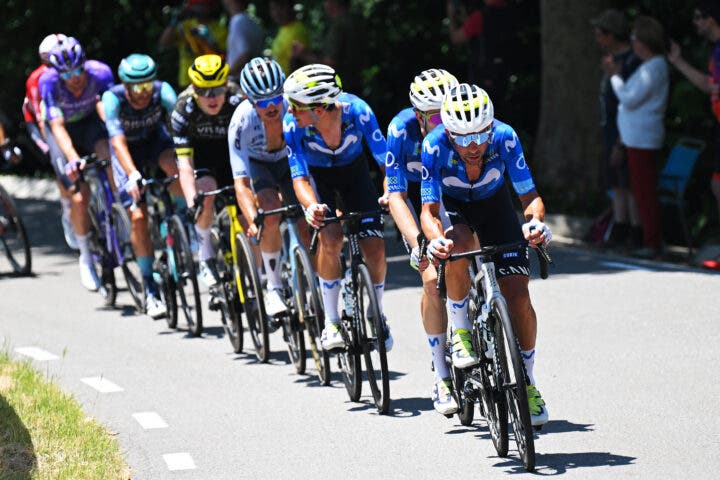
Movistar veteran Nélson Oliveira, on the cusp of setting a record for successive grand tour finishes without abandoning, was impressed by the crowds.
“I’ve climbed it a few times and this year was much more people than previous years. In the end, I had bad news about Einer. But anyway, it is what it is,” he said of his teammate.
ADVERTISEMENT
“It is not really [safe],” he said when asked by Velo. The 37-year-old struck upon the core dichotomy: an unqualified atmosphere meets lack of security.
“We want the crowd and the support, it’s not their fault, but anyway, it is what it is. I think some riders spoke a few days before that they didn’t feel safe on the climb because of all the people.
“Maybe in the future, put barriers on all of Alpe d’Huez. I know it’s hard but I think it’s a good idea.”
Frustration at accelerating and braking
The bunch appears divided on that solution. While Tom Pidcock told NOS yesterday that he is against that, two-time Tour stage winner Magnus Cort shared Oliveira’s view this morning.
“I think it [barriering the climb] would help,” he told Velo and Dutch media.
“I’m not sitting and racing up,” he said, implying he is normally not at the front of the group. “But I think it’s very frustrating if you’re attacking and just getting caught behind a climb, going full and having to slow down.”
ADVERTISEMENT
Talking to WielerFlits, Visma-Lease a Bike sports director Marc Reef was another who agreed with putting barriers on all of Alpe d’Huez so “the riders in front can have a proper race.”
“What happened today cannot continue,” he told the Dutch outlet.
“We were completely stationary several times with the team cars, while the group behind was getting closer.”
A dream for fans, a nightmare for unlucky riders
“For the fans it is fantastic,” Reef continued. “On television it probably looked fantastic as well. But for the sport, it is no longer possible like this.”
Can the Tour organization practically barrier Alpe d’Huez? It would need 27.5 kilometers – the climb’s length of 13.75 on both sides of the road – of protective metal, as well as hundreds more security or gendarmerie manpower to enforce it. That comes at a big price.
It’s a conundrum: nobody wants to lose the magic and chills that Alpe d’Huez gives.
But nobody wants blood on their bikes (like Rubio) – or their hands – in the future either.
ADVERTISEMENT
One thing seems certain: when the Tour de France returns to the mythical Alpe d’Huez, the status quo will not be enough.