Updated October 31, 2026 11:48AM
Tadej Pogačar ‘Happy to Be Alive’: More Spinal Injuries Revealed
Tadej Pogačar gives first interview since Vuelta a España crash and reveals the full extent of his struggle since then.
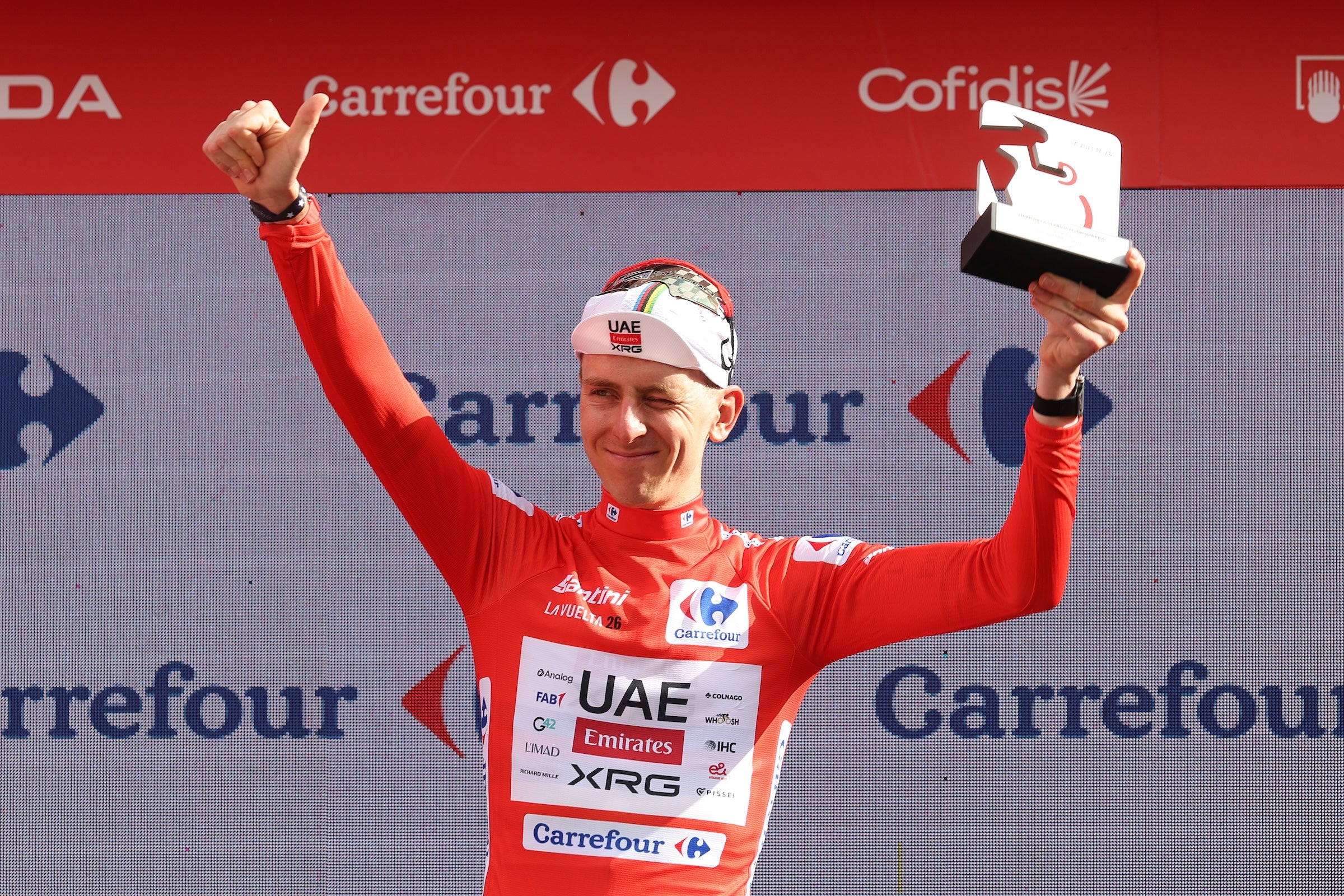
Tadej Pogačar appeared on course to win the Vuelta a España until his stage 8 crash (Photo: Alexander Hassenstein/Getty Images) (Photo: Alexander Hassenstein)
Tadej Pogačar has revealed he was more seriously injured than first thought following his crash in the Vuelta a España, with not one but three spinal fractures caused by his fall on stage 8.
The five-time Tour de France winner said the extent of his injuries only became clear in mid-October, bringing home the risks he faced of death or paralysis.
“Two weeks ago, I was in Slovenia and I went to do another CT scan. I knew I had a C7 fracture, but then we saw I had two more broken vertebrae, the T1 and T2,” he told The Athletic, part of the New York Times.
“At that moment, I was happy I didn’t do the European Championships, which had been my initial goal.
“When I saw I had three broken vertebrae? I’m just happy to be alive, actually, or just to be standing.”
The C7, T1 and T2 vertebrae are located in the lower neck and upper back.
ADVERTISEMENT
Pogačar was leading the Vuelta on August 29 and looked set to win the race for the first time. However he hit a large stone on the road approximately 33km from the finish, landing heavily and suffering those spinal injuries, a fractured collarbone and a concussion.
He tried to continue but was forced to withdraw from the race. He was brought to a local hospital and assessed, but then things took a surreal turn.
“I was just laying there and signing autographs for the doctors and nurses, taking some photos,” he told The Athletic.
“I was kind of out of it, and they were cutting my skin suit from the back, taking small pieces of the jersey, and asking if I could sign these parts of the skin suit. So my skin suit now has a lot of holes cut into it which I gave to the staff.”
Pogačar returned to Monaco several days later and was cared for by his partner, Urška Žigart. Things were initially very tough, with the Slovenian saying he struggled psychologically.
“For the first two weeks, I was really mentally not OK. I was really down. I was not a fun person to be around,” he stated.
ADVERTISEMENT
“I don’t think Urška was happy to see me around the house, because I was just, like, depressed. You know, just not feeling anything.”
Things became more complicated two weeks after his return when Žigart crashed in the Faun Tour Femmes and reinjured the jaw she had fractured in the Tour de Suisse in June.
Fortunately Pogačar was starting to feel better by then and, over time, both of them were able to return to training.
‘If I crash again it can be very problematic’
Soon after his crash his team said that his season was over. In addition to missing out on the Vuelta win he was forced to abandon his bid to retain his world championship and European championship jerseys.
Still, as the Euros approached, there were rumours that he wanted to make a return. The championships were held in his native Slovenia and, as he noted, the road race was ten kilometers from his parents’ home.
ADVERTISEMENT
He knew the roads extremely well and was motivated to return. However a follow up X-ray showed that his fracture was not healing quickly and with his team not keen for him to race, he backed off.
He subsequently found out that his T1 and T2 vertebrae were also fractured.
That poised additional risks, particularly if he fell again.
“Because it’s not as visible as a collarbone, everybody forgets about it, I think,” he said. “People who have experienced it, or know somebody that has broken vertebrae, knows how serious it is. It was strange because it was not really painful in the position where it was broken, I was focusing more on the collarbone.
ADVERTISEMENT
“But if I crash again on the bike now, it can be very problematic. Everybody says that I was lucky, and you’re always lucky after a crash where you can walk away and you’re fine. But the more you talk with people, the more you find out about the seriousness of the injury. You have the internet and you google it. You see it’s pretty serious and not to joke around. It’s a bit scary, to be honest, to think about it.”
Pogačar is back training regularly, although caution about his injuries and the danger of another fall didn’t stop him from being accused of reckless riding in Monaco.
He will continue working hard and even if the Tour de France race director Christian Prudhomme suggested that he might not get back to his previous level, will aim to have a superb 2027.
If he does achieve that, fans will be relieved that the initial consequences of his crash were not as serious as could have been.
They’ll also be relieved that he didn’t line out in the Europeans unaware that he had not one but three spinal fractures.