Published September 28, 2026 02:12PM
Power Analysis: How Brandon McNulty Won Worlds
The average effort in this tactical race doesn't tell the full picture.
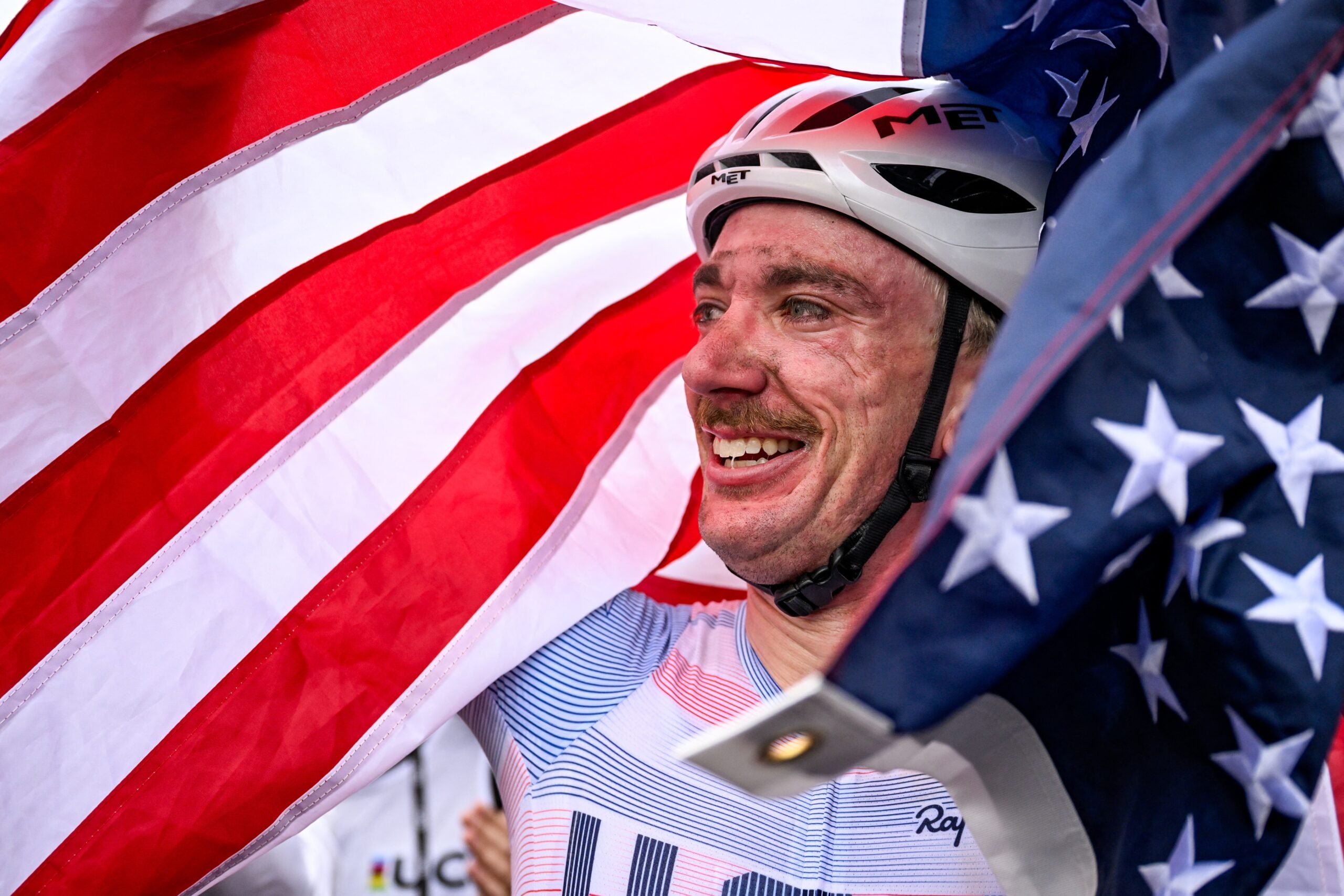
American Brandon McNulty celebrates after winning the elite men Road Race race (273,7 km) at the cycling World Championship, in Montreal, Canada, Sunday 27 September 2026. The UCI road world championships are taking place from 20 to 27 September, in Montreal, Canada. BELGA PHOTO JASPER JACOBS (Photo by JASPER JACOBS / BELGA MAG / Belga / AFP via Getty Images) (Photo: JASPER JACOBS / BELGA MAG / Belga / AFP via Getty Images)
When I wrote a preview article that named Brandon McNulty as one of the favorites for the UCI Road World Championships in Montreal, I didn’t think it was actually possible. Of course, McNulty was a previous winner of the GP Montreal, as well as a rider in form who had just finished fourth in the Worlds time trial. But he would have to beat the likes of Remco Evenepoel, Mathieu van der Poel, Wout van Aert, Isaac del Toro, Paul Seixas, and so many other riders. An American hadn’t won the World Championships since 1993, and McNulty hadn’t won a race in the entire 2026 season.
But when Team USA showed up with the strongest riders in the race, it was only a matter of time until one of those was soloing to victory. First, Quinn Simmons gave it a crack. Then, it was Matteo Jorgenson closing down key attacks. And finally, it was McNulty’s turn to go. The 28-year-old went solo with 32km to go, and held on to win by only 13 seconds ahead of Michael Matthews and Van der Poel.
This is how Brandon McNulty won the World Championships Road Race.
Before the start of the 2026 Road World Championships, there was a lot of talk about the course that resembled the Grand Prix Cycliste de Montréal. The World Championships used almost the exact same city circuits as the Canadian classic, including the Voie Camillien-Houde, a four-minute climb with an average gradient of 7.9%.
ADVERTISEMENT
The GP Montreal included 16 laps of the city circuits and Voie Camillien-Houde, while the World Championships only included 12. Instead of additional laps, the Worlds RR added 100 kilometers of flat road to bring the total race distance to 273.4km. This makes a physiological analysis of the race a bit deceiving because the average effort of the race is not a true representation of what actually happened.
Quinn Simmons, for example, went on to finish 4th with an average power of 298w (NP 379w) for six hours and 17 minutes. However, Simmons only averaged 204w for the first 100km of the race, and 346w (NP 415w) for the last 173km. For the rest of this article, we are going to focus on the second part of the race — the hard part — once the peloton enters the Montreal city circuits. While the first 100km cannot be discounted, it’s unlikely that they added a significant amount of fatigue to any of the favorites’ legs.
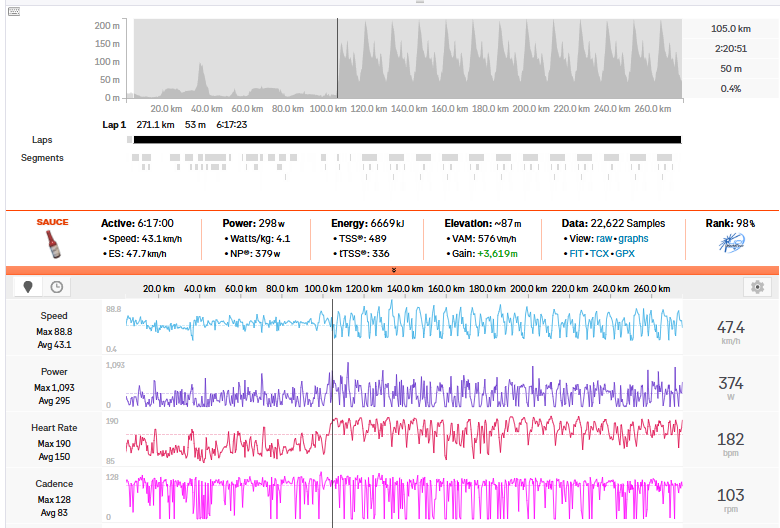
Simmons – Montreal Worlds Road Race
- Time: 6h 17m 23s
- Average Power: 298w (NP 379w)
- First 100km: 204w (NP 251w)
- Final 173km: 346w (NP 415w)
The race truly began when Bruno Amirail went to the front of the peloton and started smashing the peloton to bits. Amirail averaged more than 400w for 90 minutes, with a Normalized Power of 440w on the hilly city circuit. He even pushed the lap button on his headunit, knowing he was about to do a 90-minute time trial.
ADVERTISEMENT
In hindsight, Amirail did way too much way too early. What was the point of this massive pull? Amirail closed down the early breakaway, but that group never had a chance of making it to the finish anyway. The Frenchman didn’t set up an attack either. In fact, he rode so hard that the rest of the French team was fairly useless for the rest of the race. Their chosen leader, Paul Seixas, would cramp out of the chase group in the finale.
Amirail’s numbers are certainly impressive, but it’s the perfect example of wasting watts in a race that would reward tactics over pure strength.
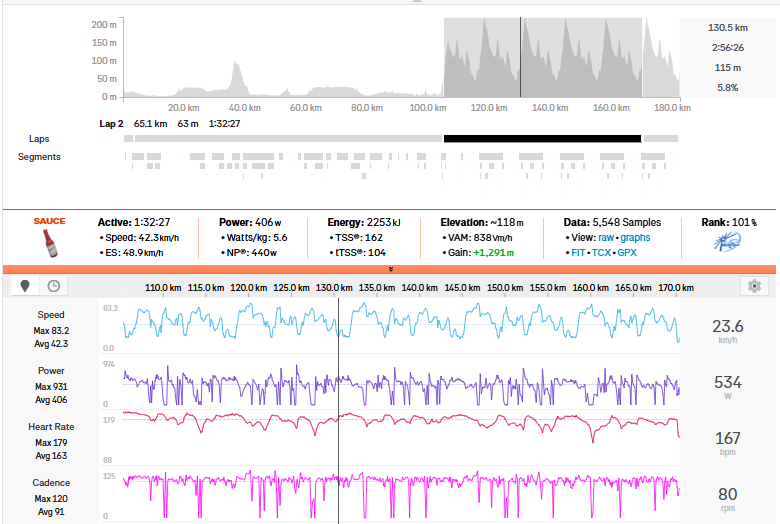
Amirail’s Epic Pull
- Time: 1h 32m 27s
- Average Power: 406w (NP 440w)
Over the next two hours, there were countless attacks from the pre-race favorites, and soon there was a group that managed to slip away. With 80km to go, a leading group of six had formed that contained Van der Poel, Van Aert, and Simmons. This was about to be a turning point in the race, and just before the peloton hit the Voie Camillien-Houde, Pidcock was forced to chase back after a mishap.
ADVERTISEMENT
Del Toro attacked halfway up the climb with Evenepoel, Seixas, and McNulty on his wheel. The Mexican kept pushing while Ben Healy and a handful of others were struggling to hold the wheel. Only 10 riders made it over the top of the climb on the wheel of Del Toro, who had just done the fastest ascent of the Voie Camillien-Houde in the entire race. Healy was one of the select few to make the split, and we can see that the Irishman pushed nearly 8w/kg for four minutes.
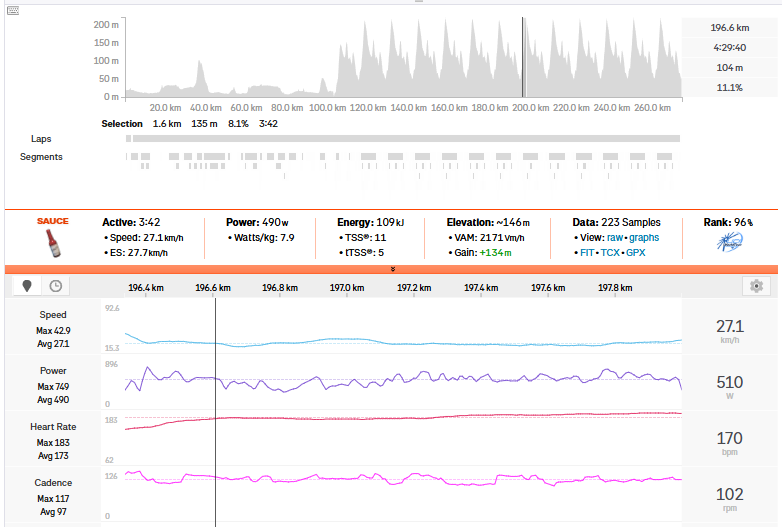
Healy – Voie Camillien-Houde with 78km to go
- Time: 3:42
- Average Power: 490w (7.9w/kg)
Del Toro and McNulty: ~8w/kg for 3:40
Following Del Toro’s attack, there was a lull in the chase group that allowed a number of riders to catch back on. Meanwhile, the lead group was split by an attack from Van der Poel, who was only followed by Simmons and Oscar Onley. If you’ve ever wondered what it takes to follow an attack from Mathieu van der Poel, look no further than Simmons’ power file: 880w for 26 seconds with a peak power of 1,093w.
ADVERTISEMENT
Attacks continued to fly for the next hour, and this is when we saw the first cracks in the pre-race favorites. Evenepoel was getting dropped every few minutes, as well as Mauro Schmid, Van Aert, and Mads Pedersen. The Dane was so far behind that we didn’t even see him until the finale…he would go on to finish sixth.
With 36km to go, McNulty and Del Toro were chatting at the back of the chase group after the Mexican had just attacked. We don’t know what was said, but 6km later, McNulty attacked while Del Toro was on the front of the group. No one reacted, and the American quickly built a 30-second lead over the next few kilometers.
The key to understanding the rest of this race lies in the reality of fatigue resistance. For the final 32km of the World Championships, every rider went slower and slower. McNulty said he was pushing Zone 2 pace up the final climb, and we’ll look at those numbers in a minute. No one was setting power PRs on the final lap. In fact, most of them were crawling to the finish.
Here are McNulty’s lap times from the Worlds finale:
- Lap 10 (attack) – 18:44
- Lap 11 – 19:39
- Lap 12 – 20:16
(In case you are wondering, Bruno Amirail’s lap times were 18:27, 18:34, and 18:40 while he was averaging 400w during his epic pull)
ADVERTISEMENT
McNulty wasn’t joking when he said that he was slowing down. On the final climb of the Voie Camillien-Houde, the chase group got within 20 seconds of McNulty, but then they stalled again. Remember how McNulty did the climb in three minutes and 40 seconds with 80km to go? It took him more than five minutes to finish the ascent on the final lap. The American was imploding, and it is actually shocking that he wasn’t caught by the chase group.
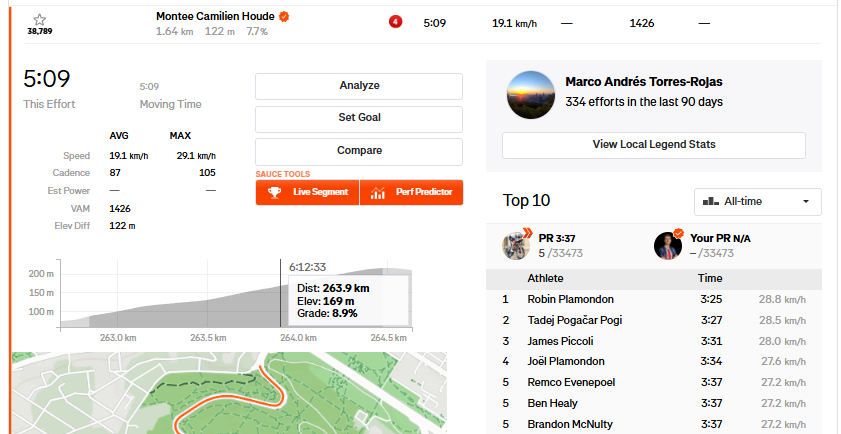
McNulty – Final Two Reps of the Voie Camillien-Houde
- 2 Laps to Go: 4:36 at ~6w/kg
- 1 Lap to Go: 5:09 at ~5.3w/kg
You can say what you want about team tactics, trade team alliances, and the decisions to chase or attack. But the fact of the matter is, no one caught Brandon McNulty, and the American crossed the line with his hands on his head and an expression of disbelief on his face. The chase group finished 13 seconds later, as it was too little too late. Brandon McNulty is the new World Champion.