Updated September 17, 2026 05:12AM
T-Rex Arms and Stumpy Thighs: How Remco Evenepoel Became 'The Aero Bullet'
Evenepoel has dominated time trialing for years, and he's poised to win a historic fourth world title in Montréal this weekend. His aero secret lies in his pint-sized proportions.
(Photo: Tim de Waele/Getty Images))
Remco Evenepoel is proof that size doesn’t always matter.
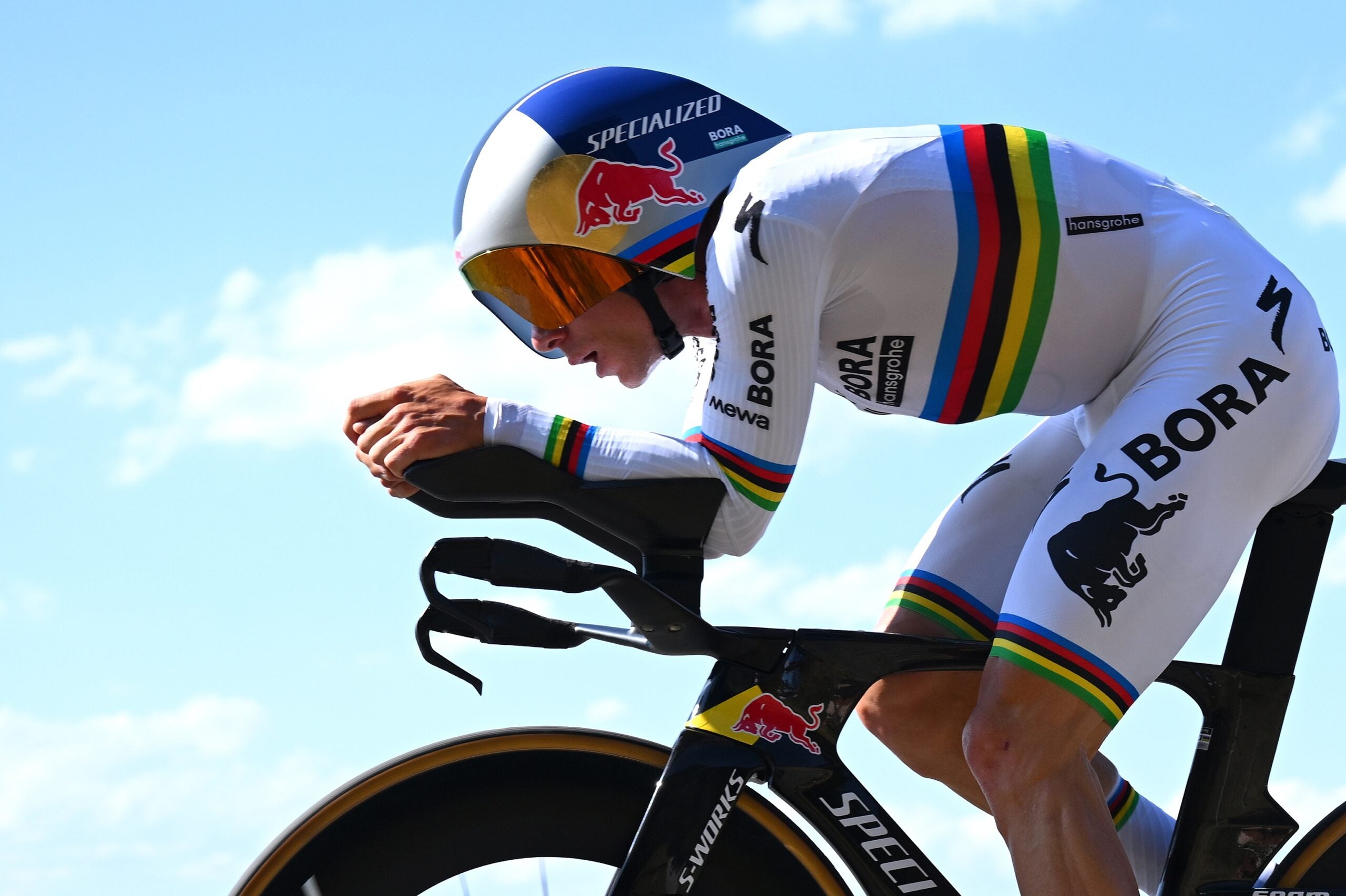
Evenepoel’s closest entourage revealed this week how T-Rex arms, stumpy thighs, and a compact core made the Belgian superstar an “aero bullet” who’s poised to win an historic fourth time trial title Sunday at the Montréal world championships.
Standing just 1.71m (5ft 7in) tall, history would suggest Evenepoel shouldn’t be one of the greatest time trialists of the era.
Look at recent dominators like Filippo Ganna, Fabian Cancellara, and Tony Martin – they’re huge. They tower over Evenepoel by 10 to 20cm, and pack countless kilos more muscle into their hulking haunches.
Speaking to L’Equipe in the mini-documentary “Evenepoel: Le Chrono Maître” [Master of the Stopwatch], Evenepoel’s physiotherapist Thijs Hertsens explained how the rider turned his pint-size proportions to his advantage.
When folded into his characteristic tight and compact TT position, the aero gains more than offset any power disadvantage he has on his super-sized rivals.
ADVERTISEMENT
“He has a very high VO2 max and a very high lactate threshold. That makes his engine very big,” Hertesens told L’Equipe. “Also what is atypical is his size, or how tall he is.
“He’s not one of the tallest TT riders we’ve seen. We’ve seen in the past a lot of very good TT riders who were above 1.80m or 1.90m,” Hertesens said.
Evenepoel’s 1.71cm stature might, ironically, be just as important as his 430w FTP.
His limbs are naturally shorter than his contemporary rivals Ganna, Stefan Küng, and Josh Tarling – and that counts for a lot.
ADVERTISEMENT
Short arms, small frontal area
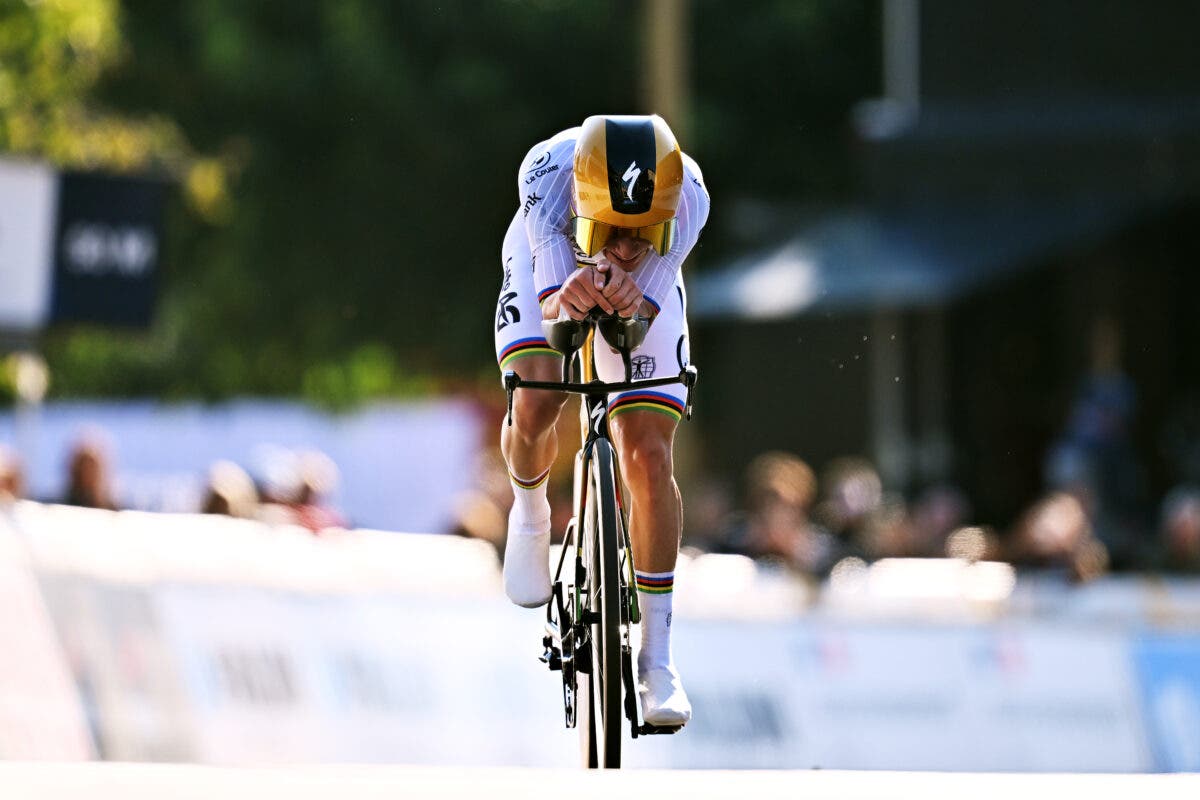
Hertsens told L’Equipe that Evenepoel’s short arms – he’s also said to have aero skin on his forearms, remember – allow him to tuck into one of the wildest positions in the peloton.
“He has quite short arms, which lets him stay close in the extensions,” Hertsens said. “The triangle he makes with his hands, shoulders, and head is really small.”
Minimizing this crucial triangle made by the helmet and hands reduces frontal area and minimizes wind resistance.
Short arms – and extreme mobility – help the diminutive dominator contort himself into his custom bars in a way that’s impossible for his long ‘n’ limby rivals.
“He can almost put his head into his trunk and into his arms, and he’s still able to look forward,” Hertsens said. “A lot of thoracic flexion, and a lot of neck extension …. That’s why they call him ‘the bullet.’”
ADVERTISEMENT
“He’s really a bullet shape.”
Short thighs, aero pedal stroke
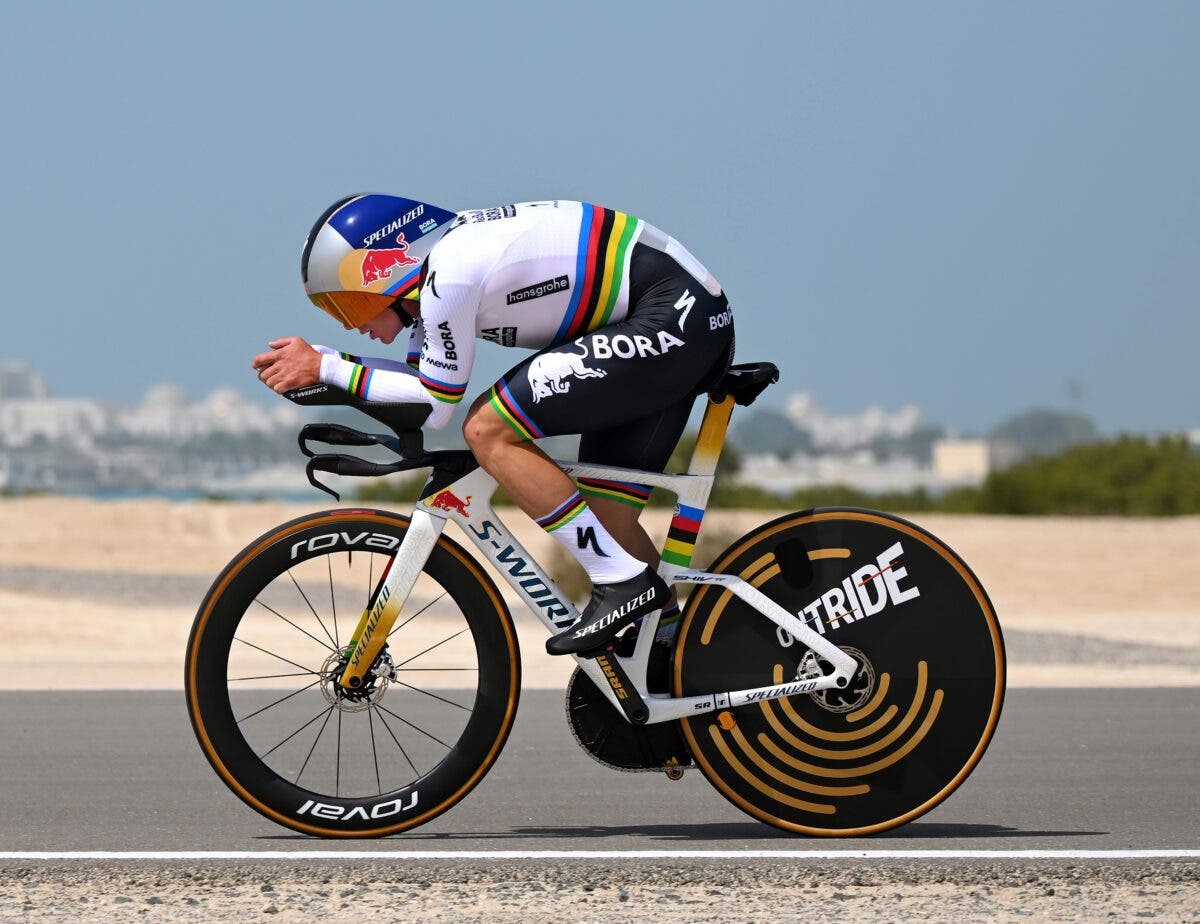
Even the most virulent TT hater can appreciate Evenepoel’s aero position.
The 26-year-old’s shoulders are only fractionally higher than his hips; his helmet and hands are one; his pelvis barely rocks. He truly is integrated with his blinged-out Shiv.
One notable thing: Evenepoel’s quad-heavy cadence, with his hips centered low and relatively forward of the bottom bracket. The angle between his hips and trunk is open, and his legs stay reasonably bent through the pedal stroke.
This is important for two reasons – and again, something partly made possible by his stature.
“What makes Remco special for sure is the length of his trunk and especially the length of his upper legs,” Hertsens said. “Those two factors are very important.”
ADVERTISEMENT
Evenepoel’s saddle position and a recent shift to some oh-so-trendy short cranks [he downsized from 172.5 to 165mm] maximize power at the pedal stroke and have a surprising aero benefit.
“His knee passes the foot a lot [as he pedals], which allows him to use more quads, more glutes, and to push harder on the pedals,” Hertsens said.
Dan Bigham, the aero guru working with Evenepoel at Red Bull-Bora-Hansgrohe, explained how this also reduces aerodynamic drag.
“When you have an extended leg versus a vertical leg, the drag difference is huge,” Bigham told L’Equipe. “It’s basically a big cylinder, so the more time you have more bent legs, on average, your drag goes down as well.”
ADVERTISEMENT
Devotion to the craft
But Evenepoel’s aero tuck isn’t all genetic freakery.
He’s had to become a master of his craft.
Evenepoel purposely adjusted his road and TT bike fits so his pedal stroke and hip position are similar on both. This mitigates the power loss many riders experience in the time trial position and reduces his need to “acclimate” his muscles to the awkward tuck.
Behind the scenes, Evenepoel devotes bandwidth to strength and mobility workouts that help him hold his freakish position for so long. He’s had to learn the art of “belly breathing” to improve lung capacity in such a cramped frontal tuck.
And of course, the “bullet” position is a constant work in progress.
Last autumn, Red Bull-Bora-Hansgrohe and Specialized sent Evenepoel to an underground Formula 1 testing facility filled with helium bubbles and lasers, not for aero testing, but to prepare for future positional trickery.
And after that, he and Bigham spent three “eight- to 10-hour days” in a wind tunnel tweaking his fit to find the perfect compromise between aerodynamics and speed.
ADVERTISEMENT
Ongoing time trial dominance don’t come easy.
Evenepoel outstanding favorite for Montréal time trial
All those hours of testing, tweaking, and finessing paid off.
This year, Evenepoel hasn’t lost an individual time trial he started.
He’ll walk up to the start ramp at the time trial world championships on Sunday with the confidence of a 68 percent winning return over the past four seasons.
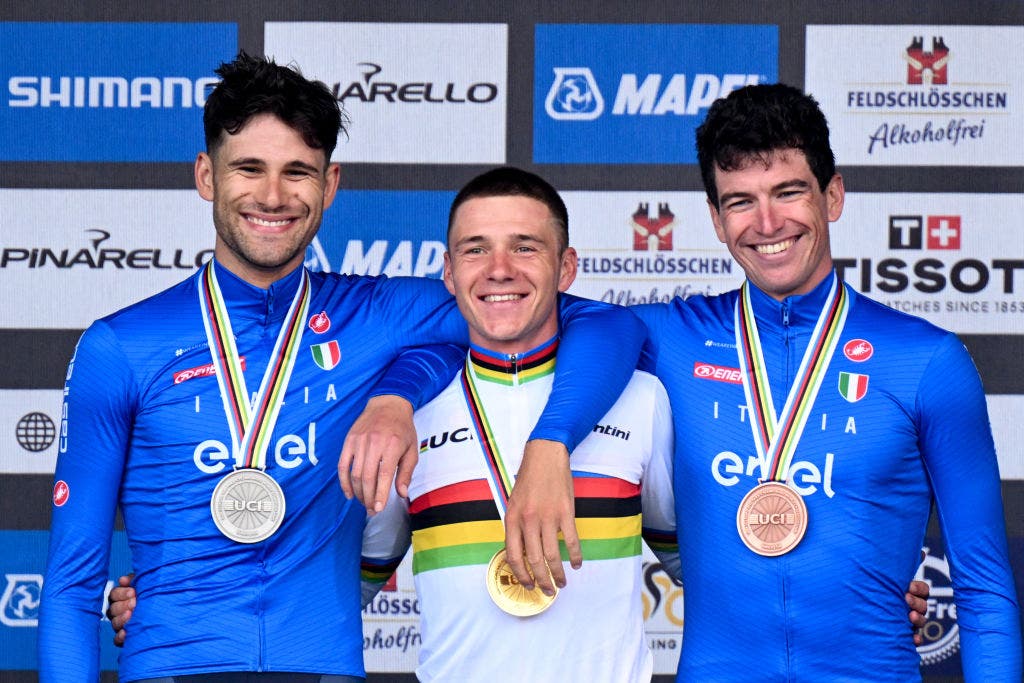
He’s now won 17 of the 25 ITTs he started since January 2023, and raked in one Olympic and three world titles in the same period.
It feels inevitable that Evenepoel will dominate in Montréal on Sunday.
With only 220m gain across a tight and twisting 39km course, the world title will go to the most aerodynamic, best-adapted rider in the pack. Ganna, Küng, and Jay Vine might be racing for second against Belgium’s “bullet” as he shoots for a rare TT-road race double.
Evenepoel won’t only become the first man to win a fourth consecutive world title if he’s fastest Sunday afternoon in Montréal.
ADVERTISEMENT
He’d also tie with Cancellara and Martin as the man with the most TT titles in history – all while being 15cm shorter than them both.